Monday, May 5, 2025

Fascinating Textile Discovery in Scotland

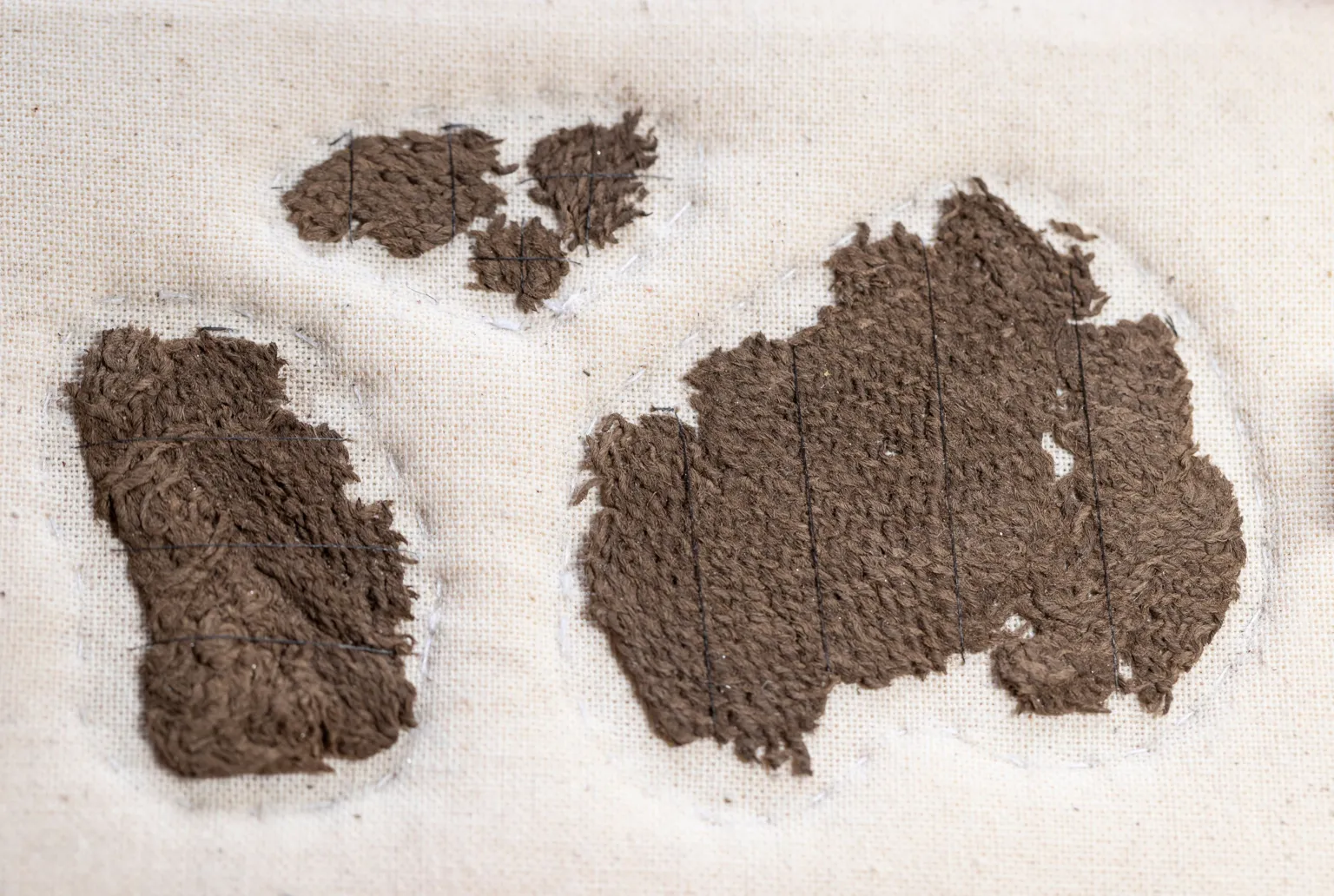
From BBC.com we have an article about a fascinating rare Iron Age textile find on display at the Scottish Crannog Centre in Kenmore, Perthshire. The article can be read here.

The wool textile, radiocarbon dated at the University of Glasgow to be between 480-390 BCE, was discovered in 1979 when an Iron Age dwelling, known as the Oakbank Crannog, was excavated on Loch Tay. (Sadly, that structure was destroyed by fire in 2021.) Previously believed to be too fragile for display, recent conservation work has made it possible to be on display at the Scottish Crannog Centre. The textile, woven of unusually fine yarn for the era, also bears remnants of what may be a hem, make it particularly interesting to historians of early costume. The BBC.com article includes a photograph of the find, which displays an interesting pinstripe textural effect.

If anyone who reads this post has a chance to visit the Crannog Centre and view the textile, please post and let me know!

Monday, March 31, 2025

New Book: Bog Fashion

I don't know how I missed the Kickstarter for this project, but I just learned over the weekend that there is a new book coming out: Nicole DeRushie. Bog Fashion--Recreating Bronze and Iron Age Clothes. (Chronocopia Publishing, 2025). The Kickstarter has ended, but Chronocopia Publishing will soon be selling the book on their website, and eventually other booksellers will have it available for sale as well. The book's page on the Chronocopia site can be viewed here, and a short bio of Ms. DeRushie can be read here.

The Chronocopia site does not indicate what the price of the book will be, but it's a hardcover book (probably in the same general format as An Early Meal, Daniel Serra's book about Viking age Scandinavian food). Still, I'm planning to buy Bog Fashion when I can, because the page about it on Chronocopia's site indicates that it will be well-illustrated as well as well-researched. Its scope is "Bronze and Iron Age fashion from Northern and Western Europe," and it includes detail from all phases of costume construction, from spinning and weaving the thread into cloth to the creation of accessories.

If, like me, you are fascinated by the clothing of Bronze Age and Iron Age Europe, you'll want this one for your collection.

Update (5/3/2025): I ordered the book from an independent seller in Missouri, USA this past week. The price I was quoted was $40 USD, plus $7 USD for shipping. Chronocopia has it for $39 USD, but shipping is likely to be more than $7 USD from Sweden. It will probably be about 2 weeks before I receive it.

Monday, January 6, 2025

How Much Fur Did the Vikings Wear?

To my readers: Happy New Year, and a wonderful 2025! Number 66 of the Archaeological Textiles Review is now available on the ATN Friends website. A table of contents for this issue, and a download link, can be found here.

I have just begun looking through that issue, and already have found an interesting article about a newly-commenced study seeking to establish a critical fact: was fur commonly used in Viking age clothing? It turns out that no comprehensive review of Viking age finds containing evidence of fur on clothing has been done to date. The few finds that document survival of fur on clothing are problematic as evidence, in part because it is very difficult to identify the species from which a fur specimen came using microscopy.

A project has recently been initiated to examine extant Viking age clothing finds in Denmark for fur and evidence about fur. The article in ATR No. 66 that discusses the project and the reasons such a study is important and necessary is: Luise Ørsted Scharff Brandt, Imported fur in Viking Age Denmark and its importance as a visual marker, Archaeological Textiles Review, No. 66, page 111.

Happy reading!

Friday, August 9, 2024

A Shallow Beret

I recently came across an article in Piecework magazine called "The History of the Beret."

The Piecework article may be read here.

The article, unsurprisingly, is short, which is fine. But the article is also shallow. The author claims that "The beret-style hat has its roots in the Basque region straddling the French-Spanish border." I have not yet explored the articles she cites in support of this statement (though that would be easy to do as all appear on the Internet and the URLs are given). But the Basque country is not the only place where beret-shaped hats have been worn, and may not be the place where they were worn first. Wikipedia has a short article about a cap called a kausia, which supposedly worn by the kings of Macedonia in antiquity "as part of the royal costume", and supposedly was worn by Alexander the Great and his Companions. I blogged about this hat, which may or may not date to antiquity, here.

Kudos to the author of the Piecework article for attempting to pin down some of the latter-day history of the beret, though! It's hard to document when a garment or other artifact originated or how long it's been around, as anyone aware of the "history" of a cord-making device called a lucet can tell you.

Margrethe Hald Archive

I have spent too much time being, alternately, busy, exhausted, and sick, to want to blog much. But the discovery I made on the Internet today is worth sharing. The Centre for Textile Research at the University of Copenhagen has made the Margrethe Hald Archive available on the Internet! The archive consists of PDF copies of papers that Professor Hald authored or co-authored during her lifetime, free to download. The page you need to access is here. Please note; most of these papers were written in Danish, not English; the PDFs are of pre-computer age originals. I first learned about Professor Hald with regard to her work on Danish textiles and shoes worn during the Iron Age, she also worked on other ancient textiles, notably in Peru. Enjoy exploring!

Sunday, January 28, 2024

An Excellent Lucet Article

Common modern lucet.

"Lucet" (or "lucette") is the name given, at least in English-language sources, to a type of device used to turn yarn into cord.  The photograph to the right, from Wikipedia, shows a type of lucet that is common nowadays, but other forms have been proposed.

10th c. "lucet" find.
I became interested in lucets because it has been often proposed (though not proven) that the Viking cultures used them to make cord.  While fork-shaped finds of bone have been made in Viking contexts, none have been, to my knowledge, associated with cord production.  The only type of device arguably linked to cord-making is a small tube with posts or prongs at the top (such as the second image from Wikipedia, a 10th century find from northern France). 

Today, I found a long article about lucets that was written by an archaeologist. The article is called "Brief History of the Lucet Braiding Tool." It can be found on the "LRCrafts website and read here.  It systematically discusses the evidence for lucets, complete with numerous photographs, some I have not seen before (including some from Southern Europe).  It even includes an instructional video on how to use the fork-shaped lucet shown above!
 
I am looking forward to reading this article in full, and I suggest that readers interested in the lucet, as well as in Viking and medieval clothing history read it as well.

Monday, December 11, 2023

New Wonders

Now that our local election is over (don't ask) and I have less pressing law business, maybe I can resume at least posting about historical costume again.

Just today, I found a wonderful website; a collection of articles, in English and Czech, about various issues relating to Northern European culture and costume.  It's called Project Forlǫg and you can find it here.  It's aimed at reenactors, but is of interest to historical costumers and is useful to anyone interested in the early medieval period in northern Europe.  Further, it's possible to search for articles on particular topic.  Topics that I have looked at so far include life expectancy; women's ages for first and last childbirths; notes on early medieval women's dress; and articles on period armor and weaponry.  Some of the articles are bibliographies of articles about a particular issue.

Nor have the organizers limited their outreach to that website.  The following text appears on the website's Editorial Board subpage, describing the resources they are making available to reenactors and researchers.  I reproduce it here with its original links intact:

"Hello.
By this, we would like to thank you for visiting the project that tries to shed light on various topics connected with Early Medieval period and historical reenactment.
We are personally devoted to Viking Age studies for more than fifteen years. Our internet journal is registered under ISSN 2788-3000, DOI: https://doi.org/10.59500/forlog and is archived by the National Library of the Czech Republic as part of the Webarchiv.cz project.
Articles presented on the websites oscillate between scientific and educational or popular style. Our priorities are plainness, factuality and humility to sources. Our results are based on the combinations of different sources. The primary goal of the project is the popularization, myth-busting and constructive criticism. Secondly, we aim to create a compendium of information about the Early Middle Ages. We hold the opinion that the reenactment and science can cooperate and mutually enrich each other. You can read the code of this project by clicking on the link.
As we think it is important to discuss about the past and to find the consensus, we encourage you to write comments here or at Viking Age Facebook group. The list of articles can be seen in Sitemap. In case you would like to support the project, please continue to Sponsorship. We also offer those interested the opportunity to use our physical library, the catalog of which can be found here.

I plan to check their website for new material as often as I can, and urge those of my readers who are interested in the early medieval period to do likewise.  Thanks to Alfrun of A Wandering Elf for posting about this website; that is how I learned about it. 

Sunday, September 10, 2023

Fashioning The Viking Age

Happy September!

During the summer I was too busy to think about historic costume, let alone blog about it.  

So it was a delightful experience to learn from the University of Copenhagen's website, that the ongoing Center for Textile Research project on Viking Age clothing (called "Fashioning the Viking Age") has led to the publication of two books so far:  "Fibres, Tools & Textiles," and "From Analysis to Reconstruction." Both are available for free download on this website.  Alternatively, one can order paper copies of the books (though not for free).  

I haven't had time to read either book yet, but they are wonderfully illustrated with full-color photographs of actual finds as well as reconstructions.  Enjoy!

Tuesday, June 13, 2023

New Ancient Rome Channel


The video embedded in this post is from a newish YouTube channel called Imperium Romanum. The presenters are based in the Netherlands, and plan to increase their production of videos in both quantity and quality and to cover all aspects of ancient Rome, including clothing and food.   

Above, I have chosen to show you a short documentary-style video about the clothing of ancient Roman soldiers and gives a good overview of the factors that drove Roman military clothing design.  Check the channel out if you have any interest in ancient Rome; the videos are short and fun to watch and contain good information.

Saturday, April 8, 2023

Stone Age Fabric

Happy Easter!  It's been a long time since I've had time to blog and the energy to blog at the same moment.

Today I found an interesting article from phys.org about cloth specimens found at Çatalhöyük, a Neolithic (New Stone Age) cite located in the area now call Turkey. Çatalhöyük was inhabited about 8,000-9,000 years ago.  Lise Bender Jørgensen, a respected textile archaeologist, recently published an article, along with other researchers, in Antiquity, an archaeological journal, about research into Çatalhöyük fabric finds, the oldest woven fabric finds currently known.  

The research showed that the textiles found at Çatalhöyük were made from plant fiber.  Interestingly, the plant fiber found turned out not to be flax or ramie.  Instead, several of the specimens found turn out to have been woven from bast fiber from oak trees.  Oak timber was used for building construction in Çatalhöyük, and apparently the inhabitants derived fiber from the oak bark for their clothing as well.  

The phys.org article may be read here.  I commend it to my readers' attention.  I do not know at present how to find the Antiquity article on the Internet, and I cannot afford to obtain the relevant issue.  If I do locate the Jørgensen article I will revise this post.

EDIT:  No, it didn't take long to track down how to obtain a copy of the article. Cambridge University Press is making the Antiquity article available on line for $26.00 USD here. I may wait until my finances improve to buy myself a copy.

Sunday, October 16, 2022

One Afternoon Tutorials--Miscellaneous Accessories

Today's collection of One Afternoon Tutorials focuses on  a few specialized accessories, such as Victorian watch fobs.  They are short projects mainly because they make small items and don't require a lot of expensive materials to create. 

Cravats.  A cravat is a neckcloth used to give varying looks to suits, mostly during the Victorian periods. The tutorial on this item, by Folkwear, the pattern company, comes with a quick bit of history for the item. 

Ribbons for Victorian Shoes.  Try the link here.

Suffragette Sashes. It is possible to buy these from vendors on Etsy, but once of those vendors made a nice tutorial on how to make one for yourself.

Victorian Watch Fobs.  This is the kind of fob that consists of a ribbon, in satin or velvet, that is about three-quarters of an inch (about 1.9 cm) and about 3 inches (381 cm) long.  They require inexpensive metal fittings.  Consult the blog of The Pragmatic Costumer, here.

I have a few ideas for posts, but mostly I haven't had time to sit down and develop them.  Hopefully, I can do that next month. 

Monday, August 22, 2022

Shawls and cloaks, part 1

Today, I discovered that Hilde Thunem has published the beginning of a new paper, this time on Viking era shawls and cloaks worn by women.  That paper can be read and/or downloaded here.

The portion of the paper that Hilde has completed is a description of the various archaeological finds that appear to be pieces from a shawl or cloak, along with descriptions and pictures, and explanations of the reasons why they nave been so categorized.  The harder part, picking through the known information to arrive at conclusions upon which to base clothing reconstructions, is not yet written.  Based on Hilde's other articles, though, it will have been worth waiting for.  

I am still reading through the completed parts of the paper and already have learned many things.  Hilde's work should not be missed by anyone interested in Viking era clothing.

---------------------------------------------------

P.S.  Sorry to have fallen behind on updating this blog, but I had a good reason:  my husband was diagnosed in June with stomach cancer.  Fortunately, it was a type of tumor that is very slow growing, and had not spread.  He had surgery in July to remove the tumor, and is now recovering well.

Thursday, June 30, 2022

Knitted Cord, Revisited

Years ago, I wrote more than one post on the subject of lucets, specifically oriented toward discussing the subject of whether the Vikings used lucets, or a similar knitting technology.   

This month, Piecework magazine has published an article on "knitting nancies," or knitting spools, spool knitters, or corkers, or any one of more than half-a-dozen other names for a simple device that makes square cord that is similar in appearance and structure to luceted cord.  The Piecework article can be read here

The author of the Piecework article,  Mary Polityka Bush, does not discuss the Victorian lucet, or the controversy about whether the Vikings used lucets (and if so, what they might have looked like).  She merely discusses what she was able to discover about the device from early modern times (i.e., late 16th century and later) onward.  

What Ms. Bush found isn't much!  She found a suggestion that a kind of "knitting frame" might have been in use as early as 1535 and that such a device was permitted to be used by professional knitters.  She also discusses modern variants of the two-peg knitter, and that such "spool" knitters could come with different (even) numbers of pegs.  But most of her article is anecdotal evidence of the use of spool knitters by 20th century fiber artists, and lovely, full-color photographs of different modern spool knitters.  

So the evidence for the invention and development of modern "spool knitters," like the evidence for Viking-era lucets, is similarly anecdotal and inconclusive.  It is even possible that the Vikings or another early people invented the "lucet" but that the invention was lost, and later reinvented--possibly more than once.   That's one reason I keep posting my little articles on the subject of knitted cord.  Maybe through collecting such snippets I may eventually locate enough information to make an attempt at solving the mystery.

Monday, May 16, 2022

Costume History--on Quora?

A few months ago, I read, on Quora, a piece about a historical costume fact of which I was ignorant, and which was genuinely interesting.  The piece can be read here (scroll down to the answer by Randy Long, former retired systems engineer; that's the piece I mean).

The gist of the article is that, in the 30s, 40s, and 50s, when men in America and Europe typically wore suits as a everyday matter, suit jackets were cut differently.  Specifically, they were cut with higher armholes that conformed to the torso much better, and as a result those jackets did not ride up when the wearer raised his arms, in the way that men's suit jackets (and women's suit jackets, for that matter) do today.  So the earlier suit jackets looked nicer and, in addition, were more comfortable to wear.

Why the change?  Because it was a lot cheaper to make ready-to-wear jackets with the low armholes--particularly for the ready-made clothing market.

If I ever make enough money again, I will order one custom-made suit, I think, with proper armholes.

EDIT (2/1/2023)  I just found a blog called Parisian Gentleman with the author's own take on the problem of modern suit jackets with armscyes (the correct word for "armholes") cut too low.  You can read it here in English or here in French.

Sunday, April 10, 2022

April HSM Project

April already.  Wow, has the time flown.

Between financial activities (work, taxes) and political (don't ask) activities, I have had little time to even think about this blog for the last two months.  However, I do have a happy development; I have decided upon an HSM (Historical Sew Monthly) project for April!  

April's HSM theme is "Bags."  I finally decided to buy myself a replica of the Great Bulgarian bronze mirror find, which is barely 2 inches (about 5 cm) across, for my birthday.  Though it's not a "Viking" piece, it's not impossible that a Viking might have obtained such an item through trade.  All I'd need to make a small drawstring bag to protect it is a small scrap of wool and a similarly sized scrap of linen, seamed together wrong side to wrong side in such a way that the seam allowances do not show, with a channel seamed in near the top for a closure.  I think I still have a small amount of thin cord that I could use as a drawstring, but if not I could probably braid some from thread if need be.  

It would be a very quick project, which is the sort of thing I need right now.  Wish me luck in actually finishing it before May!

P.S.  The blue cord I use to close my bag of (speculative) Viking age toiletries is perfect in thickness for the little bag I have  in mind, but is way too long.  I might cut some of the extra length off and use it for the little mirror bag.  


Monday, February 21, 2022

Archaeological Textiles Review No. 63

At the beginning of this month, Issue No. 63 of ATR, i.e., the 2021 issue of the Archaeological Textiles Review (formerly Archaeological Textiles Newsletter, or ATN) was made available for free download.  ATR is published by the Friends of ATN, and hosted by the Centre for Textile Research in Copenhagen.

As always, ATR has excellent professional research articles on clothing, textile, and related finds and research.  The subject matter of its articles ranges throughout history and prehistory and is worldwide in scope.  They consider themselves an "open source" journal and for years have made all of their back issues available, all the way back to ATN No. 1, here; just look at the left-hand side bar and select the link for "Download issue".  

But I'm writing about ATR again now because their latest issue has an amazing number of articles about Viking age textiles and/or clothing, and I thought that those of my readers interested in Viking age clothing would be interested in reading them.  Here is the list, complete with the page in the current ATR issue on which each article starts.  Judge for yourself.   All articles in ATR come with bibliographies that are a gold mine for further research.

Julia Hopkin.  Raincoats or riches? Contextualising vararfeldir through multi-perspective experiments. (Page 31)  The article describes the author's physical experiments involving making samples of different types of fabric, including vararfeldir, the shaggy "fake fur" exported by early Iceland, in an attempt to gain insight as to what qualities of vararfeldir made it valuable and desirable during the late Viking age.

Vedeler, Marianne. Golden textiles from Gokstad. (Page 47)  The author describes early textiles woven with precious metal thread, including two textiles found in the hollowed-out ridgepole of the burial chamber of the Gokstad Ship.

Jørgensen, Lise Bender, Moe, Dagfinn and Lukesova, Hana.  Viking Age textiles and tapestries: drawings by Miranda Bødtker. (Page 58)   Miranda Bødtker worked for many decades making technical drawings for botanists, zoologists and archaeologists at the Bergen Museum in Norway.  The article gives a brief account of her life (she passed away in 1996 at the age of 100!) along with excellent photographs of some of her drawings and of the textiles they depict.

Mannering, Ulla.  Fashioning the Viking Age: status after the first three years. (Page 138)  Parts one and two of this project were concluded in 2021, and the article summarizes the results.  They include full color photographs of two reconstructed outfits:  a man's outfit based upon the Bjerringhøj grave find, and a woman's outfit based upon the Hvilehøj grave find.  

For readers whose clothing interests predate the Viking age, the following articles may be of interest as well.

Nørgård, Anna.  Reconstructions revived:  a handweaver's personal perspective. (Page 90) A long, well-illustrated essay about well-known reconstructions of ancient Scandinavian clothing by a woman personally responsible for many of them.  With good photographic and sketch illustrations.

Grömer, Karina, Ungerechts, Silvia and Reschreiter, Hans.  Knowledge sharing:  a newly found 2,700-year-old tablet-woven band from Hallstatt, Austria.  (Page 115)  The article describes a newly-discovered tablet woven band, and provides a weaving diagram, in full color!  The band itself is depicted on the cover of Issue No. 63, and a color photograph of the reconstructed band appears in the article.  

Grömer, Karina, Saunderson, Kayleigh and Pomberger, Beate Maria.  Metallic idiophones 800 BCE to 800 CE in Central Europe:  their function and acoustic influence in daily life. (Page 129) "Metallic idiophones" are metal ornaments fastened to clothing that make noise by jingling, rattling, or clinking.  This article discusses some of them and discusses ways to discover how they sounded when worn.  Well-illustrated with color photographs, sketches, and graphs.

Enjoy!  

Friday, January 14, 2022

Historical Sew Monthly 2022!

It's a new year, and the Historical Sew Monthly marches on!

To be sure, I haven't done any costume projects for years, and still owe pictures for the last (small) one I completed.  Moreover, in November I started a new, part-time job with weekly time expectations.  

But I have not given up hope on actually doing costuming work again.  And I'm finding the new HSM Challenges inspiring.  The list is below:  I have cut and pasted it from The Dreamstress's blog; my comments on each appear in bold after the text for each challenge.

January: Anniversary Choice: It’s the 10th year of the HSM! Go back 10 years and choose any challenge from the 2013 HSF Challenge list, and make something for it! In 2013 we tried to do this fortnightly, so there are 26 options!  I still have many projects for which I have at least bought the materials, though I'm pretty sure I won't manage this by the end of January.

February: Neck & Shoulders: Make something to wear around your neck or on your shoulders.  There is my volva cloak, though to trim that completely may take me a while.  The lambskin hood is better; I started mocking up a pattern.  Perhaps I can finally nerve myself to save up for and buy the necessary materials....

March: Non-Woven. Make something not based on woven materials. There’s a whole world of possibilities. Braiding, carving, crocheting, felting, knitting, knotting, naalbinding…and…felting!  Felting has always interested me.  Perhaps a fez-like hat, to accompany an Assyrian outfit (see December reference below).  Or maybe start again to learn sprang by making a bag or a hood?  A sprang bag could fit under the challenge for March or April!  

April: Bags: Make a bag! Easy-peasy, if uninspiring.  If I had not made a Viking-style bag with wooden handles, that might have been an option.  I need to think about this one.  EDIT:  2/19/2022  I will make a small, drawstring bag, to hold a small polished bronze mirror, 1 and 9/16ths of an inch (4 cm) across. The Fairy Tales Chest on Etsy sells such mirrors, a replica of a find from Great Bulgaria during the right time period (8th-10th c. CE), and I've almost decided to get myself one as a birthday gift.  Sprang would be fun but I'll probably just sew a little bag instead; heaven knows I have enough scrap wool and linen lying about.  It will probably be a wool bag with a linen lining.

May: Protection: Create a garment that protects you from something: weather, dirt, wear, weapons, etc.  The volva's cloak, it haunts me....

June: At the Museum: Be inspired by the items and research available in museums and archives.  Need to think about this one.  Possibilities abound.  Perhaps my long-planned Kostrup-style apron dress?

July: Geometry: Make something with pattern pieces based on basic geometry, or that somehow incorporates geometric design elements.  I still have the white wool that was going to be the volva's tunic; maybe this is the year to get that done!  Like most pre-medieval and medieval garments, it's assembled from geometric shapes based on the measurements of the intended wearer.   EDIT:  2/19/2022  This should be simple enough to do, even if I sew it entirely by hand, as I plan to do.  

August: As Seen On Screen: Make something inspired by something you’ve seen on screen, whether it’s film, TV, or YouTube.  There are plenty of YouTubers demonstrating constructing of historical styles, many incorporating authentic techniques.  Need to think about this one too.  

September: Colour Challenge: Blue: Make something in any shade of blue.  My planned Vendel apron dress leaps to mind. The fabric for it is a deep blue, and making it will be simple; a line of sewing down the side, and at least a hem around top and bottom would do it.   EDIT:  2/19/2022  Also simple.  In fact, simpler than the volva's underdress; it would simply be a hemmed tube sewn closed along one long side.

October: A Perfect 10: It’s the HSM’s 10th anniversary, so make something 10 themed. 10th century, the something-10s, something that incorporates 10 of something? Be creative with it!  Perhaps revive a project that I've had pending since 2010?

November: Fitting: Make something that focuses on fit.  Socks?  Or the volva's hood?

December: New Era: Make something from a decade or century you’ve never made from before, or make something that represented a new era in fashion in its time.  I've been admiring Angela Costello's forays into ancient Assyrian costume.  Perhaps an Assyrian tunic? Wow.  That would be quite a leap! 

Friday, December 31, 2021

Sponged Wool and Hard Times

Recently, I learned about a kind of fabric called "sponged wool."  Sponging was, and is, a technique used to pre-shrink wool and give it a more luxurious texture.  It commanded premium prices because it can't be used on industrial-sized lengths of fabric; an explanation as to why can be found here.  

Sponged wool is still being made (check out this page for one such fabric being sold), but in the early years of the 20th century, it was particularly fashionable--and many European immigrants to the United States earned a steady, if low, income sponging wool.

This article talks about how early 20th century immigrants ended up in the sponged wool business.  In particular, it describes the career of one such immigrant, B.S. Moss, who went from working as a sponger to running his own wool sponging business and finally to making a successful career for himself in the budding motion picture industry.

This isn't the type of post I usually write, but I wanted one more post to go up here before we start the year 2022, in which I hope to devote more attention to learning about clothing history and making my own projects again.  Happy New Year!

Friday, November 19, 2021

And Then There Were Two....


Loyal readers will recall my posts about Zola, my wonderful orange cat who I lost to heart disease at the beginning of this year, and Empire, the cheerful black and brown tabby we adopted to fill the hole in our home (and hearts).

Then, in the summer, we learned that the adoption of Crispin, Empire's brother, had come unstuck and that Crispin needed a new home.  Would we take him?   When we learned that he had gone into rut (because his prior adopter never got him neutered) and was fighting intestinal parasites, we couldn't say no.  Especially when he was so nice to us despite his health problems. 

It wasn't easy at first, and he still has some issues, but Crispin is slowly coming to believe that we love him and that our home is now his forever home.  And, to the surprise of everyone but my husband, the boys apparently recognize each other as brothers.  Or, at least they have never been hostile to each other and now spend a lot of time playing together and hanging out together.  So it makes sense for me to show the two of them together.  

In the kitchen photograph, Crispin is the one on the floor.   In the other, he's the one facing the camera.  As always, click on the picture for a larger more detailed image.  I have taken better photographs of these two, but I couldn't resist the symbolism (bookends!) of the doorway shot.

Friday, October 8, 2021

What About NESAT XIII?

A few weeks ago, I wrote about my success at obtaining a PDF copy of NESAT XII, Aspects of the Design, Production and Use of Textiles and Clothing from the Bronze Age to the Early Modern Era (Karina Grömer and Frances Pritchard, eds.) from the publisher, Archaeolingua.  

Today, I thought it might be worthwhile to make an effort to find NESAT XIII, Links Between Past and Present (Milena Bravermanová, Helena Březinová, and Jane Malcolm-Davies, eds.), which was published by Verlag Beier & Beran Archäologische Fachliteratur.

Abebooks appears to still have the book in soft cover for $70.25 USD plus $18.48 USD shipping. I wasn't able to navigate the publisher site, which is written mostly in German.  Perhaps the PDF option will be adopted after they run out of soft cover copies of the book.

As for NESAT XIV, the conference was only recently held (online) this summer; the volume has not been published yet.    But abstracts for the presentations may be found here.  

EDIT:  (10/11/2021)  As the commenter noted, there are a few publicly available videos of NESAT XIV talks.  You can find them here