Showing posts with label bog blouse. Show all posts

Monday, March 31, 2025

New Book: Bog Fashion

I don't know how I missed the Kickstarter for this project, but I just learned over the weekend that there is a new book coming out: Nicole DeRushie. Bog Fashion--Recreating Bronze and Iron Age Clothes. (Chronocopia Publishing, 2025). The Kickstarter has ended, but Chronocopia Publishing will soon be selling the book on their website, and eventually other booksellers will have it available for sale as well. The book's page on the Chronocopia site can be viewed here, and a short bio of Ms. DeRushie can be read here.

The Chronocopia site does not indicate what the price of the book will be, but it's a hardcover book (probably in the same general format as An Early Meal, Daniel Serra's book about Viking age Scandinavian food). Still, I'm planning to buy Bog Fashion when I can, because the page about it on Chronocopia's site indicates that it will be well-illustrated as well as well-researched. Its scope is "Bronze and Iron Age fashion from Northern and Western Europe," and it includes detail from all phases of costume construction, from spinning and weaving the thread into cloth to the creation of accessories.

If, like me, you are fascinated by the clothing of Bronze Age and Iron Age Europe, you'll want this one for your collection.

Update (5/3/2025): I ordered the book from an independent seller in Missouri, USA this past week. The price I was quoted was $40 USD, plus $7 USD for shipping. Chronocopia has it for $39 USD, but shipping is likely to be more than $7 USD from Sweden. It will probably be about 2 weeks before I receive it.

Wednesday, October 12, 2016

Nalbinding in Unexpected Places

"Tailor's" buttonhole stitch.
Original graphic by Grace Christie,
"Embroidery and Tapestry Weaving",
 downloaded from Wikimedia Commons
Open buttonhole stitch.
From "Ancient Danish Textiles", p. 284 
Now it's October, and I'm still working on nalbinding at odd moments.  I have no news to report on that project, but while looking for more information about nalbinding I learned a few interesting facts that relate to nalbinding and that may not be commonly known.  In particular, simple nalbinding turns up in textile finds where I did not suspect it existed.

The one that surprised me most is that the neckline of the Skyrdstrup blouse is decorated with a few lines of nalbinding.  I learned that from Susanna Broome's booklet, Nalbinding from Finds. The stitching is what we know of today as "buttonhole stitch."* However, if you work buttonhole stitch along a line of previously worked buttonhole stitch, or along a loop of thread, instead of through fabric, the result is a very simple form of nalbinding.  Ulrike Claßen-Büttner, in her recent book "Nalbinding - What in the World Is That?: History and Technique of an Almost Forgotten Handicraft," (Books on Demand 2015), calls this technique "simple looping"(page 21) and classifies it as a simple nalbinding stitch.
Twisted buttonhole stitch.
From "Ancient Danish Textiles," p. 284

In "Ancient Textiles from Bogs and Burials", Margrethe Hald discusses the Skrydstrup blouse and other instances of buttonhole stitch that were used as ornamentation.  One might deduce from this that the humble "buttonhole" stitch had many decorative uses in antiquity and the early medieval period.  Hald notes that at least one find of a cap worked in open buttonhole stitch has been found.  More interestingly, a scrap of textile worked in twisted buttonhole stitch, a variation of buttonhole stitch, was found at Ordrup Mose and has been dated to the New Stone Age (Hald, p. 283).

Another interesting use for buttonhole stitch involves using it to create loops for a button, toggle, or similar fastener.  On her blog, "Research Dumping Grounds", Mistress Sylvie la chardonnière discusses Penelope Walton Rogers's analysis of 6th century CE Kentish finds which indicate that Kentish women fastened their long coats with a brooch though such loops, worked in linen thread.

The lesson here, as is so often the case in examining archaeological textile finds, is not to import one's assumptions into the examination.  Many of us do not think of buttonhole stitch as embroidery, let alone an art that can create a textile, but it's clear from early finds that it has been used that way, and that use of needle looping (which is what the term "nalbinding" means) goes way back into the distant past.  Clothing technologies change, and any study of pre-modern costume must remain alert to that fact.


* Some people equate "buttonhole stitch" with "blanket stitch", but the two stitches, though very similar, are not the same. This site has a good explanation of the difference.  By the definition provided on the Nordic Needle, Hald's diagram of buttonhole stitch on p. 284 of "Ancient Danish Textiles" is actually blanket stitch, which is why I have not reproduced it here.

Saturday, May 31, 2014

The Bog Blouse, in wear

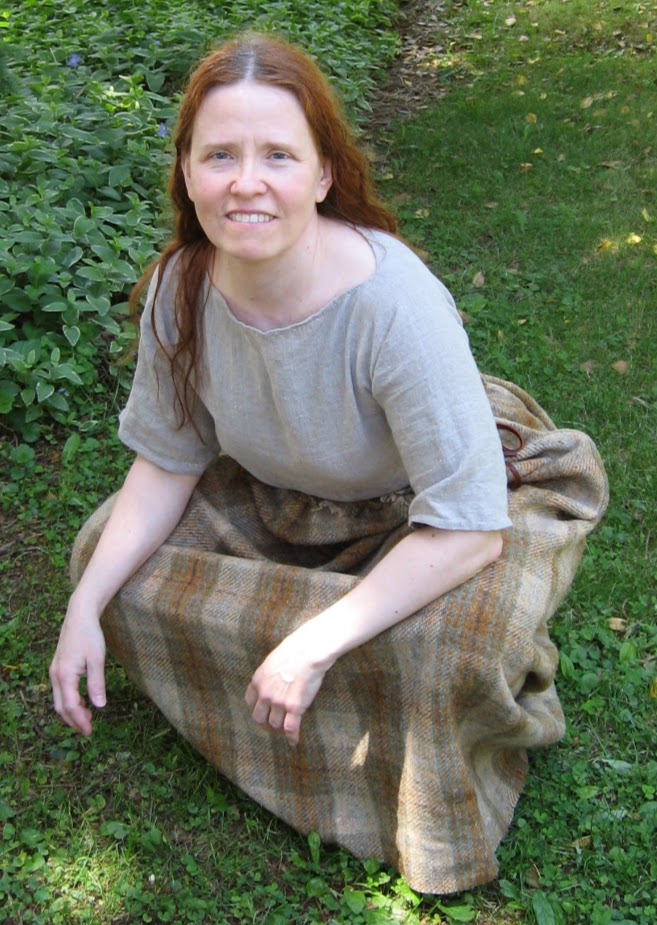
Here are some long awaited photographs of my Bog Blouse, being worn.  The images are clickable for a larger version.

The blouse tends to pull uncomfortably around the armpits and the tops of the breasts, and the neckline binds a bit when the blouse rides up, but it looks surprisingly good when I have it on.  I made the skirt years ago, based on the Huldremose skirt; it's 100% wool in a 2/2 twill weave (which is period) but my idea that the pattern of the plaid is period is based upon rank speculation.    Still, the two garments look well together--and what's more, they look period, and that pleases me.  (I'll make a better-fitting bog blouse again, sometime).  All three photographs were taken by my loving husband.  Please forgive the funny facial expressions--I can't always manage to smile on command.

On my haunches--a more period posture, at least
The blouse, at rest
The outfit in (too) bright sunshine

Saturday, March 8, 2014

The Bog Blouse

Egtved Girl's costume*
Borum Eshøj woman's costume*
I just realized that, due to my new employment, I have already missed the deadline for Historical Sew Fortnightly Challenge #4, the "Under it All" challenge for which I intended to make the wool shift.   Since there are other challenges that the shift will fit into, I will make it anyway, but for now instead of starting it, I should be doing Challenge #5, the "Bodice" challenge, which is due March 15.  Fortunately, my planned project for this challenge is not only simple, but requires so little sewing that it should be quick to complete also.

For the bodice challenge, I plan to make what I'm calling a "bog blouse"; the kind of elbow-length blouse found in the Egtved Girl's grave and other Bronze Age bog finds.  The challenge calls for making a "bodice," and this type of garment is as close to a separate bodice as one gets in European costume history before about 1500 C.E. or so.

The "pattern" is very simple.  All you need is a rectangular piece of fabric.  You make two cuts in the sides, each about equal to the distance between the desired armpit location and the desired sleeve end.  Fold down the top portion of the rectangle to make the sleeves, and cut a suitably-sized slit for the head.  Fold the two flaps created by the cuts toward each other, and seam together for the body of the blouse.  Hem and finish the seams as necessary for your chosen fabric, and it's done! This woman made a blouse based upon the same pattern for an HSF challenge in 2013.

The original blouses of this type were made from wool, but given the poor survival rate of linen in Scandinavian soils, archaeological finds of flaxseed as early as 100 C.E., and recent evidence indicating that linen, hemp and nettle apparently were used to make fabric and clothing earlier and more commonly in Scandinavia than was previously supposed, it did not seem too speculative to make such a blouse from linen. When I got the idea for this project, I had about $13 USD worth of credit at fabrics-store.com, the web store where I buy most of my linen for Early Period projects.  So I used my credit to obtain a meter of medium-weight linen fabric in a brownish-gray color the seller calls "natural".  A photograph of the fabric appears on the right-hand side toward the bottom of this post.

My fabric (photo by me)
Undyed linen can be different, pale colors ranging from light brown or yellow to gray depending on how it is processed.  The "natural" linen I purchased was shown as a light reddish brown on the website, but looks more gray in reality, which in my opinion makes it truer to the place and period of my costume.  I don't plan to try to copy the Egtved girl's skirt; instead, I will wear a long wool plaid fabric skirt that I made  long time ago which is based on the Borum Eshøj and Huldremose finds. The Borum Eshøj find consists of several graves, one of which is a woman, estimated to have been in her mid-40s, who was wearing a complete blouse and a long wool skirt. There is no blouse in the Huldremose find, but the National Museum of Denmark's page on the Huldremose woman indicates that linen fibers were found close to her body, suggesting that she might actually have been wearing a blouse or shift made from linen next to her skin that has almost completely vanished with decay.

After I complete the blouse, I will try it on with the skirt and post photographs and relevant construction details.  Eventually, I hope to have a sprang hairnet to wear with it also.

EDIT:  3/19/2014  Revised the first paragraph to say what I meant it to say originally (I haven't even gotten to cutting into the wool for the shift, so far).


*All images from Wikimedia Commons unless otherwise credited.