Showing posts with label bronze age. Show all posts

Monday, April 12, 2021

New Source of Information About Early Textiles

This week, courtesy of Katrin Kania, I learned about a free, searchable database of scholarly publications.  It's called Digital Vetenskapliga Arkivet, or DiVA, and it allows one to search for books, dissertations, and articles published by scholars at nearly 50 different universities in Scandinavia. (The above link goes to the English language version of the home page; for the Swedish version of the home page, go here.) Best of all, DiVA is absolutely free to use.  You can go directly to the DiVA search page from here. 

Naturally, DiVA includes dissertations, articles, and other works that are not related to textiles, clothing or the Vendel and Viking Ages.  In addition, many of the works findable via DiVA are not in English.  However, I still found an excellent work relevant to textile-related Vendel period studies with my first search:  

Malmius, Anita.  Burial textiles: Textile bits and pieces in central Sweden, AD 500–800 Doctoral Dissertation, Stockholm University, Faculty of Humanities, Department of Archaeology and Classical Studies (2020 (English))

I am really looking forward to reading this volume of Anita Malmius's work, which on first glance appears very comprehensive.  I look forward to further searching on DiVA for other useful papers when I have more time (and brain energy!) to invest.  In the meantime, by means of this post I hope to make DiVA available to more costume researchers, and perhaps to people with different reenactment-related interests as well.

Wednesday, May 30, 2018

Book Review: Extending Knowledge of Costume Through Art Analysis

From the Casemate Academic website

From the Casemate Academic website
The two books I have obtained for my costume history library most recently involve very different historical periods but a common method; they both seek to increase our knowledge of clothing from their respective periods through a through analysis of period art.

These are the books I mean (links below are to the hardback editions, but e-book versions of both are available, and my copy of Woven Threads is an e-book):

I have finished reading Iconic Costumes, but am still thinking my way through the material, and I am still reading Woven Threads.  Even so, there are some observations I would like to make about both that, in my opinion, demonstrate that both books are well worth reading.

Iconic Costumes seeks to obtain information about costume from the Migration Period through the Viking Age by examining and analyzing the details of artistic depictions of human beings in of Viking and pre-Viking Age Scandinavian art.  Most of this art is in the form of carvings on artifacts such as the Oseberg cart, guldgubbar (tiny, thin gold-foil plaques found in graves), or jewelry.  In contrast, Woven Textiles primarily analyzes surviving frescoes from buildings erected by the Minoan and Mycenaean Bronze Age cultures in order to learn more about costumes and patterned textiles depicted in those frescoes.  Both books reference non-artwork archaeological finds to support their conclusions.

Professors Shaw and Chapin have an easier time than Professor Mannering, for all that few textile remains survive from either culture, because despite its peculiar lack of perspective to a modern eye, Minoan and Mycenaean art is much more representational than early Scandinavian art, and has the additional benefit of having been originally created in color (and the colors survive to a surprising degree) while early Scandinavian art is mostly sculptural in nature.  Early Scandinavian art is also highly stylized, and the human figures depicted are nearly always too small to show much detail.  The Aegean frescoes often showed human figures life-sized, or close to life size, and many of them survive nearly complete and in good condition.  Even the fragmentary frescoes have much to say about patterns that may well have been used to decorate fabric.

That being said, both books manage to answer a significant question relevant to the history of clothing for their period of study.   It's the same question for both books:  Does period art really reflect what people actually wore as costume?

The authors' answer in both cases is "yes."  Having observed and analyzed most of the human figure representations dating from Iron Age Scandinavia, Professor Mannering observes: 
The vast majority of the iconographical costumes recorded are encountered in the archaeological textile and clothing material.  At the same time, there is information on the depictions [sic] that is not seen in the archaeological textile finds and vice versa. ... 
A typical male outfit in the Late Iron Age consisted of trousers, a tunic with sleeves, a rectangular cloak, belt, and shoes, while a typical female outfit included various dresses, skirts, blouses, cloaks, hairnets, and shoes, demonstrating both continuity from previous periods and new trends. ...
Generally, the investigation shows that the depictions represent clothing items that occur in the archaeological record. ... Thus, the depictions reveal costume items, e.g., kaftans, female jackets, and skirt and blouse ensembles that most likely were present in the archaeological record in the Late Germanic Iron Age, but that have not been positively identified yet.  They also demonstrate that the female dress most likely was long-sleeved, something which has not yet been securely documented via the archaeological record. (pp. 176-177) .
Professors Shaw and Chapin focus more of their efforts on comparing Minoan and Mycenaean styles by means of the surviving pictorial art.  They rely heavily on Elizabeth Wayland Barber's work as support for their conclusion that the patterns observed in clothing shown in fresco art could have achieved on textiles.  Like Professor Mannering, they conclude that certain patterns likely were used on real clothing from the fact that the same patterns turn up in clothing depictions on multiple frescoes.   However, there are enough surviving decorated fragments of cloth in archaeological finds to support Professor Barber's belief that patterned cloth was produced in the Aegean during the Bronze Age.  There is also support in contemporary Egyptian tomb art, which shows foreigners wearing garments, decorated in patterns, that compare closely to the Aegean fresco designs.

In general, Shaw and Chapin show that the creation of patterned textiles (whether through weaving, embroidery, applique, block printing, or other textile-related arts) came from centralized workshops, centered upon the great palaces of the Minoan and Mycenaean civilizations, and that such items were worn only by the elite; ordinary folk made do with plain cloth.  It appears that Mycenae produced less elaborate fabrics and costumes, and reserved the more elaborate ones they did produce for unusual occasions.
Artistic evidence for how the Minoans themselves defined the luxury in luxury textiles is not confirmed by recent archaeological discoveries surveyed in Chapter 2.  Artists working in the Neopalatial era depicted their best fabrics as finely woven with colorful and complex patterns and embellished with decorative borders, fringes, and tassels; these pictorial details are consistent with the bits of surviving textiles.
*   *   *   *
The few fragments of cloth--all linen--that survive from Mycenaean contexts support the impression that Mycenaean textiles were plainer and less decorative than textiles of the Minoan era.  Linen fragments found in Grave Circle B at Mycenae and in a tomb at Ayia Kryiaki on the island of Salamis, for example, were tabby-woven (a plain weave) and undecorated.
*   *   *   *
Some Minoan-styple forms of costume, particularly festal attire with flounced skirts, continued to appear in Mycenaean art, particularly in procession frescoes, but the fanciest rapport patterns of earlier generations were replaced by simple striped designs or by fabrics woven with uncomplicated all-over scatter patterns.  Decorative bands that reinforced edges, seams, and hems on bodices, skirts, and tunics were still made by the Mycenaean weavers, but even these were plainer than before.  (Chapter 9, italic emphasis in original).
Both books are well-illustrated with excellent photogtaphs of items of the period artworks that were analyzed.  Understandably, most of the illustrations in Iconic Costumes are black and white or line-drawings, but there are also some color pictures of actual clothing finds and guldgubbar.  Woven Threads includes both color photographs of surviving frescos and portions of frescoes as well as colored illustrations of particular pattern motifs.

There is a large amount of food for thought in both books.  (For example, Professor Mannering concludes that the scale of the female figures in period art makes it impossible to draw conclusions about women's wearing of the two-brooch costume--e.g., the "apron dress" or "smokkr".)  I think people interested in the history of clothing should read them, whether or not they are interested in the clothing of the Bronze Age Aegean or Iron Age Scandinavia, just to observe how the authors analyze and apply the different types of clothing evidence available to them.

Monday, September 11, 2017

Bronze Age Zipper?

The video to the right of this post is a recent Internet discovery of mine.  It shows a modern replica of Bronze Age sword belt and purse,  found in a grave at Hvidegården,  Denmark.

Ørjan Engedal, a professor at the University of Bergen and an archaeologist who is also an artisan, made a bronze sword with a scabbard, a small leather bag, and a sword belt, based upon the Hvidegården find.  The bag, or pouch or purse or whatever you want to call it, has an unusual closure.  The closure is a series of closely-spaced, alternating leather loops through which a long bronze pin is thrust.  The result looks much like a modern zipper though the method of closure is simpler in that no slider is used.

The Hvidegården grave was actually discovered in 1845; a brief article about it in Danish may be found here. Apparently the grave is thought to be one of a shaman or wizard, based upon the odd contents of the "zipper" pouch; they include (as best I can make out from Google Translate's English rendition of the article) a razor, a small wooden cube, a seashell from the Mediterranean, and part of the jaw bone of a squirrel.

It seems to me that the existence of this pouch is some support for the position that "there is nothing new under the sun."  In other words, the idea of a zipper-type closing certainly was possible before the zipper as we know it was invented; it probably did not become an acceptable closure because, with Bronze Age technology, it was fiddly and awkward to make and a bit awkward to use.  A technology spreads when the infrastructure necessary to support the manufacturing process and the materials needed are readily available and result in an easy-to-use product that fills a common need.  That is as true for clothing and bags as it is for computers and cars.

Sunday, August 6, 2017

More Short Tutorials--Early Period

It's no secret to any of my readers that my favorite costume interests lie with the early period, which I think of as from the dawn of humanity until the high Middle Ages.  Today's crop of tutorials consists entirely of projects appropriate to early period costume.
  • From Jenn Culler's blog there are two simple and fun projects.  
    • First, a tutorial on how to make a peplos dress that hangs more appealingly than a pinned sheet of fabric (what's called a "bog dress" in the SCA). The technique is not documentably historical, but also cannot be ruled out on the basis of archaeological finds. 
    • Second, there is a tutorial for making a Bronze Age Dress based upon a design suggested in this article by Karina Grömer, Lise Bender Jørgensen and Helga Rösel-Mautendorfer. The article discusses different ways to recreate the clothing of a woman buried in a Middle Bronze Age grave in Winklarn, Austria.  (Other potential reconstructions of the Winklarn woman's costume are suggested in the article, for those who might be interested.)
  • From opusanglicanum there's a tutorial on how to stitch the acanthus motif from the Mammen find.   
  • From Ragnvaeig's LiveJournal there's a tutorial on how to stitch the linked circles motif from the Oseberg ship find.
  • And, finally, from Anna's blog, Anachronistic and Impulsive, there is good information on how to make ancient Roman garb for both men and women. Note too the current post where Anna seeks donations because she and her husband are in financial difficulty due to unexpected calls on their savings. 
All of these projects would be good to work on during a hot summer, if it is summer where you live.  Enjoy exploring them!

Wednesday, March 15, 2017

Recreating the Egtved Skirt

A day or two ago, I rediscovered the Facebook page of the Friends of Archaeological Textiles Review, which I recommend to historical costume buffs, particularly those interested in early period costume.  There is pure gold in some of the URLs posted on that Facebook page.

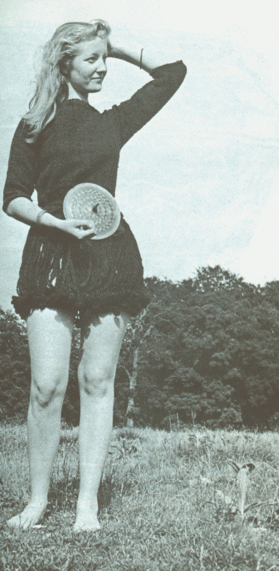
The most interesting item I have discovered on the Friends of ATR page so far is the video that appears to the left.  This video shows Professor Ida Demant, an archaeologist at Sagnlandet Lejre in Denmark, making a reproduction of the Egtved skirt, and explaining what she is doing, in English, while she is working.  The basic technique is to make a tablet-woven belt, leaving long weft loops, and twisting the loops together to make the thick fringe.  The video concludes with a few seconds of footage showing a young woman modeling the finished product for an outdoor audience.

To watch Professor Demant make this skirt is to acquire a new appreciation for the skills of textile workers in ancient times.  I commend it to anyone interested in the making of textiles as well as to persons interested in Bronze Age costume.

Sunday, March 5, 2017

Fine Fabric In the Bronze Age

Many people who aren't knowledgeable about historical costume assume that clothing in early times, including the Bronze Age, was coarse and heavy and bulky to wear.  

Early Greek and Roman sculpture show that that wasn't true in the Mediterranean--the fine drapery shown in those sculptures could not have been achieved with coarse fabric.  And archaeological finds from early Egyptian tombs show their skill at thin, translucent, fine linen. 

Somehow, it's hard to imagine fine fabrics showing up in northern Europe much before the Middle Ages.  The Hammerum dress, for example, was brightly dyed and well-woven, but rather thick and graceless in appearance, if the recent reconstruction of the dress by Museum Midtjylland is a realistic guide.  But a recent discovery in England, of all places, suggests that fine fabric was not worn solely in southern Europe during the Bronze Age.  The Independent published a news article summarizing the discovery here.

According to the article in The Independent, the site is about 30 miles northwest of Cambridge at a place called Must Farm near Whittlesea, Cambridgeshire, and the finds are approximately 3,000 years old. Over 100 different textile fragments have been found there so far, along with evidence that textile production took place at the site.  The finest specimens found are linen, and appear to have been of sizes that would naturally be used for draped garments, according to the article, which reports:
Some of the yarn is of superfine quality – with some threads being just 100 microns (1/10 of a millimetre) in diameter, while some of the fabrics themselves are so finely woven that they have 28 threads per centimetre, fine even by modern standards. It’s likely that some of the fragments of textile are from items of clothing.
Originally, some of the textiles must have been of very substantial size – because they had been folded, in some cases in up to 10 layers. If made to be worn, these folded fabrics may well have been large garments, potentially, capes, cloaks – or even large drapes, perhaps similar to those known from elsewhere in the ancient (and sometimes modern) worlds – the ancient Greek chiton, the Roman toga and the Indian sari. A drape folded into 10 layers for temporary storage would have served as a substantial garment – potentially up to 3 metres square (i.e. 9 square metre).
There is no evidence that the fabrics found had been dyed, but this is not surprising due to the difficulty of dyeing linen with the vegetable dyes available during the Bronze Age.

There is other evidence that this site was the location of a wealthy village.  Jewelry items, notably glass beads, were also found, and the beads appear to have come from the eastern Mediterranean, probably Syria or Turkey.  Metal tools and articles, such as tweezers and razors, axes and awls, were found, along with wooden buckets and ceramic bowls and containers.  The evidence also indicates that the site was burned less than a year after it was built, and then was depopulated--food and food items found in place indicate that the people didn't just move away but were killed, enslaved, or both.

If you care about early material culture, including clothing, in Europe, keep an eye out for information about Must Farm--there is a lot of material to analyze that may completely change our view of the cultural history of northern Europe.

Monday, May 25, 2015

Another Opportunity!

As I mentioned before, the spare brooch I offered a few weeks ago to the first interested reader of this blog is not the only duplicate item I have that might be of interest of readers of this blog.  Here's another one:

As some of my readers may be aware, books in Osprey's various military history series vary a lot in quality, both in terms of the clarity of the writing and  the depth and documentation of the information provided. This one is better than average.   It has a lot of good, clear photographs of period art (i.e., frescos, pottery remains) showing military figures in action, and some photographs of surviving weaponry and armor remains, in addition to Osprey's famous artwork depicting reconstructed figures.  In fact, as one of the reviewers of the book on Amazon.com noted, the book concentrates more on clothing, armor, and weaponry than on period battles, fighting and tactics.  If period clothing, armor and weaponry are among your interests (and if you're reading this, likely they are), you may want this book.  It's in brand new condition.  If you would like more information about the book, please check out this page on Osprey's web site.  (There is a "look inside" link on the page which for some reason was not working for me; this Amazon page provides views of the table of contents and quite a few other pages, including pages with illustrations, inside the book.)

Bronze Age Greek Warrior currently retails for $18.95 USD/£11.99.  I'm certain I paid less (I bought it on EBay, and the only reason I would do that with a book in print would have been to get a bargain), but I cannot find the original item write-up on EBay and the packing slip does not state the price I paid.  Moreover, Paypal doesn't keep records far enough back for me to locate the payment record that way.

So I will handle this item the same way I handled the brooch, i.e., by setting a price low enough to make this a reasonable purchase even if I end up sending it halfway around the world.   I will send the book to the first person who contacts me (via comments or otherwise) who is willing to pay $12.00 USD plus shipping by book rate (or the equivalent, if such a rate is applicable in shipping to the buyer's address).  My e-mail address is cathy at thyrsus dot com.

EDIT:  (5/26/2015)  I have an interested party for the book.

EDIT:  (6/4/2015)  I've learned tonight that the person who bought it has just received it.  

Thursday, February 26, 2015

HSM Challenge #2--A Blue Iron Age Skirt, Completed!

Remember the last project about which I said, "No battle plan survives contact with the enemy'?  Well, I had another "battle plan" moment when I tried to make my Vendel period apron dress.  

After I had hemmed all the edges of my fabric and sewed it into a tube, it became brutally clear that the amount of fabric I have was simply too narrow to make a properly draped peplos for me to wear--unless I pinned it on only one shoulder, and I know of no archaeological support for a one-shouldered overdress in 7th-8th century Norway. 

But I quickly discovered that the tube was perfectly sized to make a long drawstring skirt, of the type found on the woman found in the bog at Huldremose.  That seemed appropriate to me, particularly since it has recently been discovered that the Huldremose plaid skirt was actually a  blue plaid, and not the brown plaid that it appears to be today.  

The Huldremose skirt has holes carefully made a little below the top edge of the skirt and a thong threaded through them to serve as a drawstring, but my blue fabric is too thin to tolerate such treatment.  So I settled for shortening and evening out the top edge of the tube by cutting off about three or four inches or so, folding down the edge and sewing it down to make a drawstring channel.  Then, I cut down and sewed the cut-off fabric piece into a drawstring using the same sewing technique that is used to make apron dress straps (i.e., cut a strip of fabric a bit longer  and about three times wider than you want the string to be, fold the sides inward, and whipstitch the two folded edges together so that the raw ends are enclosed inside; push the ends into the narrow tube you've created and stitch each end closed). 

So for the second time this year, I've completed a challenge with an item that isn't what I intended to make for the challenge.  Still, I'm happy with the skirt; that color is too lovely for the fabric to have continued to go unused.

HSM Challenge #2--Colour Challenge Blue

Fabric:  A yard of 60+ inch wide vintage wool fabric in a period twill weave.

Pattern:  None needed; this skirt, like the Huldremose skirt, is a tube with a drawstring at the top.

Year:   Sometime between 160 BCE and 340 CE.

Notions:   100% silk Gutermann thread in a similar blue shade.

How historically accurate is it?   Only somewhat.  The weave is period, the basic tube shape is period, and the color is not too unlike what might have been obtained with woad in period by a patient and skilled dyer.  But the original skirt didn't have a drawstring channel, and I've never heard of a period garment that used either a drawstring channel or used a cut-and-sewn strap for a drawstring.  So maybe 50-60%.

Hours to complete: About 2 1/2 hours, though I didn't keep track of my sewing time very closely.

First worn:  Not yet. I haven't even tried the skirt on; I've been too tired to do much as I'm fighting off what appears to be a bad cold.  Photographs will be coming soon (unless I've *really* screwed up and the skirt is unwearable).

Total cost:  Effectively zero.  The fabric cost me less than $10 USD nearly 5 years ago, and I've had the silk thread for a long time from other projects.

EDIT:  (2/27/2015)  Huldremose is an early Iron Age find, a fact I keep forgetting, for some reason.  Since it's the inspiration for this costume item, I've corrected the title to reflect that fact.

EDIT:  (3/13/2015)   Corrected description of how I made my drawstring by deleting the word "four" and replacing it with the word "three", in boldface, in the description above.

Wednesday, December 31, 2014

Inspiration from a Christmas Present

This year was not a big year for Christmas presents at our house, but I did receive a wonderful present from my husband. Like most presents he and I exchange, this one is a book.  Unlike most of the books I've received from him, this one blends elements of costume and military history.  Here's the citation:
Aldrete, Gregory S., Bartell, Scott & Aldrete, Alicia.  Reconstructing Ancient Linen Body Armor:  Unraveling the Linothorax Mystery.  Johns Hopkins University Press, 2013.
Though it's a small book, Reconstructing Ancient Linen Body Armor contains a surprising amount of information, which I'll probably blog about after I finish reading it.  Right now, I'm more interested in talking about the experimental approach taken by the authors and their helpers took to their material, which is nearly as interesting as their discoveries.

The authors sought to maximize what information exists about the linothorax--a type of ancient body armor made from linen.  They reviewed the scholarly literature (surprisingly sparse), references in ancient writings, images in Greek art (surprisingly plentiful; the authors found nearly 1,000), and experiments with actual prototypes based upon their research.  

As I read, it occurred to me that one task Professor Aldrete and his colleagues performed might be useful to me as a researcher of Viking age costume; compiling a data base of human depictions in period art.  Unlike the art of the ancient Greeks, Viking art is not representational; it is highly stylized, sometimes to the point where it becomes debatable whether a particular figure was intended to be male or female.  Still, an actual list of pieces depicting human figures would be more useful to me than the Pinterest boards I've assembled, particularly if I group the items by date and find location.  Hopefully, I can begin the project this weekend.

Wednesday, July 2, 2014

Dartmoor, in 2000 BCE

Totanac figure wearing ear spools*
Maya ear spools made of jadeite**
By now, most people interested in early period historical costuming have probably read something about the Bronze Age archaeological find in Dartmoor, England. The first article I saw on the subject was this article in The Guardian. This website by the Dartmoor National Park Authority contains more information, both about the archaeological work and about each of the components of the find, and I commend both to my readers' attention.

The most striking detail about the find, as all of the news coverage has noted, are the wooden buttons or studs.  They are significant from a history of technology perspective simply because they are direct evidence that wood turning was practiced in Great Britain 4,000 years ago--no finds have demonstrated wood turning at such an early date before.  (The archaeologists believe that the studs were locally made because analysis of the wood indicates that they were made from the wood of a tree known as a spindle tree, a type of tree which still grows in Dartmoor.)  
Faience ear spool-Egyptian Middle Kingdom***

From a costumer's perspective, the studs are also interesting because of the possibility that they were worn as ear ornaments.  (There is an opposing theory that they might have been some kind of dress fastener, though I think it's harder to see how the objects in question could have been used in such a capacity.)  Similarly shaped ornaments have been found in archaeological contexts for other cultures, such as the Mayans, the Totanac (ancient Mexico), and the ancient Egyptians.  The famous mask of King Tutankhamen, and many images of the Buddha, show earlobes with holes wide enough to support this type of ornament.  So it doesn't seem beyond possibility, to me, that people in Dartmoor were wearing such studs, or ear spools as they are also called, 2,000 years before the birth of Christ.

However, there are other interesting artifacts related to costume, even more interesting than the debatable ear spool find, that the popular press has not bothered to discuss.  The Park Authority's website describes these with tantalizing brevity:
  • A cloth and leather belt?  Another artifact is a textile, woven from nettle fiber, with two rows of leather binding and a fringe of leather triangles, made from calfskin, stitched to the outer edge.   Chemical analysis failed to detect traces of dye in this object.  Currently it is thought that the object, measuring 345mm (about 13.5 inches) by 260mm (about 10.3 inches) may have been part of a belt.  
  • An armband?  A band 175mm (about 7 inches) long was discovered to have been woven from cow hair.  It is ornamented with round objects that have been determined to have been made from tin.  Tin is available in the Dartmoor area, but this artifact is the earliest example from a prehistoric context demonstrating its use.
  • Beads!  Over 200 of them were found, 7 of them made from Baltic amber.  About 90 of them were made from shale, and over 100 were fashioned from clay.  One, a large barrel-shaped bead, is also made from tin. This assortment is the largest number of beads found to date from a single Early Bronze Age burial in South West England.  
Archaeological finds excite me, no matter what period and culture is involved, because they are an opportunity to watch the boundaries of our knowledge of historic costume being expanded.  As science becomes able to discern greater amounts of information from minute scraps of textile and other objects, the possibility of learning what men and women were wearing in Bronze Age Dartmoor grows.  I hope to live to see much more of this process unfold.


*      Photograph from Wikimedia Commons.
**    Photograph from Wikimedia Commons. Artifact from the Los Angeles County Museum of Art.
***  Artifact and photograph From the Virtual Egyptian Museum, http://www.virtual-egyptian-museum.org/ Accession number AI.VS.00336.

Thursday, April 3, 2014

The Bog Blouse, Complete

New bog blouse--Front
Offered for your examination; my (rather) late Bog Blouse for HSF Challenge #5.  Once I finally nerved myself to start it, the Bog Blouse didn't take that long to complete (though it took longer than I'd hoped; see below).  During a less busy month, I might actually have managed to complete it close to on time.  So why did I hesitate?  Because I was afraid I would not be able to remember where to place the necessary cuts and would ruin my fabric to no avail.

In an attempt to avoid this fate, I dug out the original bog blouse I had made years ago from polyester imitation linen. Surprisingly, it still fits me quite well. Because the original blouse was long enough to tuck into my bog skirt as I wished, I decided to use it as my pattern in placing the cuts for this version. Photographs of my old, poly "bog blouse" (which was also hand-sewn) and the finished product for this Challenge appear below.

My fears, it turns out, were not groundless.  As I tried on the blouse-in-progress, I could tell that it was more snug through the body than the original. Worse still, the arms appeared to be too tight around the bicep and through the armpit, as I had feared, knowing that my biceps are now larger than they once were.  Yet I couldn't risk not making fully enclosed seams, in light of the fact that the raw edges of the fabric were already very frayed, particularly along portions of the main horizontal seam across the back and under the sleeves.  (I improvised by cutting small strips from the leftover linen pieces and stitching them over the areas where the seam allowance was closest to non-existent.)
New bog blouse--Back

Careful trying on of the blouse while I was finishing the seams has convinced me that the new blouse fits adequately, though it's more snug than the poly-linen version I made years ago. I'm a bit puzzled about the difference in fit, but the fact that the 100% linen I'm using frays so badly (forcing me to use more fabric width in sewing the seams) may have had something to do with it.  Or maybe it's just the fact that I can't measure by "eye" very well--and that's what I tried to do in making the cuts for the sleeves.

The Challenge:  #5  Bodice.

Fabric:   One yard of tabby-woven 100% linen in "natural", a grayish brown, from Fabrics-store.com.

Pattern:   Deduced (by others) from actual Scandinavian finds.  I used my last version of this kind of garment to place the cuts for this one.

Year:  1350 B.C.E., more or less.

Notions:  Londonderry 100% linen thread, in white, 80/3 thickness.  As always when I sew with linen thread, I run the thread over a cake of beeswax a few times each time I rethread my needle, before beginning to sew.  A bit of plied cord (in red or blue wool, perhaps, though I haven't found a supplier for such stuff since Wooded Hamlet stopped selling it) stitched around the neckline would have looked marvelous, but no such ornamentation appears in the archaeological finds, so (with regret) I did not attempt to add any.

My original, poly-cotton bog blouse
How historically accurate is it?  The basic pattern is from the Borum Eshøj find (other bog blouses are a bit different in cut if not in principle).  As far as I am aware, all of the bog blouses that have been found have been made from wool, not linen, but there is increasing evidence that more linen was worn in Scandinavia, and worn earlier, than was previously supposed.  Also, I do not know what types of stitches were used to make the Borum Eshøj blouse or other blouses of this type, so I finished my seams in much the same manner I used for my Byzantine himation. The originals might not have been finished in that manner because they are wool which has less tendency to ravel, but linen blouses of the same type (if any existed) might well have used a flat-felled or other seam treatment that encloses all raw edges.  So maybe 60-70%.

Hours to complete:   Roughly 4 hours, done in bits and pieces whenever I had a few minutes to spare over most of the last two weeks.

First worn:  Not yet.   I've only tried it on to check the fit.  I will try it on with the wool skirt originally made for the poly-cotton version of the blouse, and post some pictures of the outfit soon.

Total cost:  $0.  The fabric I got for accumulated store credit only, and the thread was originally purchased long ago for other projects.

Saturday, February 8, 2014

First Adventure in Sprang

The third Historical Sew Fortnightly project is to make something that is pink.  I have decided to use this project as justification for an experiment in sprang by making a sprang hairnet.  A search of Etsy revealed a suitable quantity of wool in a pink shade I found appealing, and purchased.  A picture of the wool may be found to the right of this post.

Pink wool!
Next, I needed something to use as a sprang frame. After rejecting the idea of using branches from my yard (too brittle) or my tablet-weaving loom, with dowels or something similar tied to it (too unwieldy), I decided to go with a tested, but thoroughly modern idea--a sprang frame made from PVC pipe and right-angle connectors (pictured). After soliciting some advice from a string-geek friend, I decided to make the frame 18 inches by 28 inches, with the tied-in support pieces being 16 inches each.  That size should give me enough room for a variety of future sprang projects, assuming that I succeed with this one.

I have also been reading different web sites, seeking clear and detailed explanations for how to warp a sprang frame and actually do some basic sprang weaving.  Here are the ones that look the most helpful to me so far.

Blue's videos on sprang working, the first one of which is embedded in this post.

Phiala's handout on basic sprang:
http://www.stringpage.com/sprang/sprang1.html

Gwynnyd's handout on basic sprang:
http://www.ceilingpress.com/Resources/BasicSprang.pdf

The Sojourning Spinner's basic sprang tutorial:
http://thesojourningspinner.blogspot.com/p/learn-to-do-sprang.html

Now, I have to find some suitably sized sticks to hold the weave, and then nerve myself to warp my frame and start experimenting.   Since my home is still without power and I have paying work to catch up on, how soon I can get to this project is debatable.

Less debatable is how authentic I'm going to try to be.  At this point, I'm not attempting to recreate any particular type of sprang hairnet; I just want to make a basic piece of sprang that can be fashioned into a net or cap. Particular patterns can wait until I've learned the basic technique.  

Monday, March 18, 2013

Corded Skirts From Bronze Age Denmark

Those of my readers who are interested in early period costume or in the role of textiles in archaeological discoveries should check out the following article, which discusses the unusual fate of an interesting grave find:
Bergerbrant, Sophie, Fossøy, Sølvi Helen, & Jørgensen, Lise Bender. Ginderup--Textiles and Dress from the Bronze Age Gleaned from an Excavation Photograph. Archaeological Textile Review, Issue No. 54, pp. 14-18. (2012).
Ginderup is the location of an ancient burial mound in Denmark, which was excavated in 1933.  According to the article, the central grave, grave A, was a stone cist that was about 1.7 meters long and .25-.45 meters wide.  It contained skeletal remains and a quantity of jewelry:  a neck ring, a fibule, a metal item shaped a little like a chess pawn that the authors call a "double button," two arm rings, and a finger ring.  Based on these metal artifacts, the grave was dated to the period 1300-1100 BCE and its occupant deduced to have been a woman.  There were also a number of textile remains, some quite large. Before proceeding further, the team took two clear photographs of the grave in situ.

In an attempt to create conditions that would allow the grave to be examined in more detail, it was decided to remove the entire cist without touching its contents. This was done by covering the grave first with sand, then with tissue paper, then with plaster.  The side stones of the cist were removed and the sand/paper/plaster treatment repeated for all sides.  Then they built a wooden box around the encased grave and shipped it to the National Museum of Denmark for excavation in the museum's conservation laboratory.

More than 70 years later, Bergerbrant, Fossøy, and Jørgensen became interested in Ginderup, and started looking for information about grave A. They could not locate a report about the ultimate excavation of the grave block, nor could they find any surviving textiles from the grave.  All they had to work with were the initial sketches and report of the excavation team that removed grave A from where it was found, the two photographs, and a casual reference in a work by H.C. Broholm and Margrethe Hald suggesting that the occupant of the grave had been wearing a corded skirt. 

Early recreation of Egtved woman's
costume (Photo: Wikimedia Commons)
Lacking any better information, Bergerbrant, Fossøy, and Jørgensen scrutinized the photographs in light of other Danish grave finds of similar date, and accumulated enough information to arrive at a reconstruction of the Ginderup woman's costume. Their conclusion is that she was wearing a short blouse with elbow-length sleeves and a short skirt made of twined cords, like the costume of the Egtved woman (also found in Denmark; go here for some wonderful zoomable photographs of the surviving textiles from Egtved).

There are interesting differences between the Ginderup and Egtved burials, and the archaeologists were able to derive information about those from the photographs as well.  The Egtved woman was buried in a hollowed-out oak trunk, apparently specifically shaped to serve as a coffin, not a stone-sided box, and she was covered with a large piece of cloth believed to have been a blanket. Covering textiles also appear to have been part of the Ginderup burial.  The stone cist in which the Ginderup woman was laid was "more or less covered with textiles". The authors of the article identify a large coarse cloth (3.5-4.5 threads per cm) woven in tabby.

Like the Egtved woman, the Ginderup woman wore a corded skirt to the grave.  However, Bergerbrant, Fossøy, and Jørgensen conclude that it was constructed somewhat differently than the Egtved skirt--and in fact was made differently from all other corded skirts found in Denmark from the Bronze Age:
Most skirts have cords constructed as cabled plied threads, S2Z2s or Z2S2z, and two skirts have cords made from 2-ply threads, Z2s or S2z (Fossøy and Bergerbrant in press).The Ginderup cords, however, are Z3s, plied of three single threads. In total, more than 20 cords, 3mm thick, the longest c. 12 cm, can be identified on the western side of the burial, i.e. by the left hand of the deceased. As one cannot see the top of the skirt it is hard to say how different this corded skirt is from the other known fully or partly preserved corded skirts. The photographs do, however, indicate that the lower part of the skirt is made in a manner similar to that of the fully preserved Egtved skirt, i.e. the cords end in a thread ring made from the end of the cord. A thin thread has been twisted tightly around the ring to make it thicker and to keep it together. A string is threaded through the rings, above the rings two twined threads can be seen. Together, these keep the skirt in place. (p. 17)
I found this article inspiring for two reasons.  One is the reason emphasized by its authors, namely, that even good photographs can provide enough information to attempt the reconstruction of clothing from a grave find.  Although the authors do not specifically say so, the story of the Ginderup grave is an object lesson in how important it is to preserve as much information about a grave find as possible, because one cannot be certain how much information will survive long enough to be studied and interpreted.

The other reason, however, is that until I read it, I had not been aware that the Egtved woman's costume was not unique, and that there have been other Bronze Age finds of corded skirts in Denmark.  (Apologies to my Scandinavian and European readers, who may well have long been aware of this fact.)  That matters because the types of questions one asks, and the deductions one tends to make, are different once enough evidence has accumulated to confirm that a costume is not unique to the occupant of a single grave.  Evidence that multiple women wore the corded skirt raises questions about what its wearers had in common, whether it was worn as an everyday costume or for some type of religious or other special occasion, and so on.   The article has changed the way I think about the Egtved woman, and made me more interested in looking out for information about similar burials in the future.  Unsurprisingly, the article's authors are currently working on a study of Bronze Age corded skirts that is likely to be well worth reading.

Finally, you don't have to take my word about Bergerbrant, Fossøy, and Jørgensen's research.  Although Issue No. 54 of ATR is not yet freely available, this particular article can be downloaded for free from academia.edu, a site where researchers both professional and amateur researchers alike share knowledge.  An account is needed to access the site, but accounts are free, and the site is searchable.  Whether your interest lies in Bronze Age fashion or other areas of history or science, academia.edu is a useful tool for any researcher, including researchers of historic costume.

EDIT:  (4/19/2013)  Ms. Bergerbrant and Ms. Fossøy recently published another article, this time in Textile: The Journal of Cloth and Culture, in which they discuss the evidence for the manufacture of corded skirts. This article is, to my knowledge, not available for free download but can be purchased from Ingenta Connect for $32.99 (plus tax) here.

Thursday, May 20, 2010

Bronze Age Scandinavian Clothing

A few weeks ago, I found a link to a free download of an interesting book about clothing in Scandinavia during the Bronze Age.  The citation is:
Bergerbrant, Sophie (Stockholm University, Department of Archaeology and Classical Studies). Bronze Age Identities: Costume, Conflict and Contact in Northern Europe 1600-1300 B.C. (Bricolour Press 2007).
Although the author is more interested in exploring what Bronze Age clothing signaled about the wearer's gender and societal role than about what the clothing looked like or how it was made, there is a lot of information about Bronze Age clothing finds  in the book.  The finds from Skyrdstrup, Borum Eshøj, and Egtved are among those described, illustrated, and discussed in some detail. I recommend the book to anyone curious about those finds and looking for more information about them.

I am still pondering what I'm learning from Ms. Bergerbrant's book, which challenges a number of assumptions I hadn't realized I was making.  One of those assumptions is that the long tube-shaped garment found at Huldremose was worn as a peplos.  Ms. Bergerbrant questions that belief, which  apparently is based upon a hypothesis by Inga Hagg.   Doubt about whether the peplos was worn in the Bronze Age in Scandinavia is interesting to me because Professor Hagg, among others, has hypothesized that the apron dress is a descendant of the peplos.  If the peplos was not worn in pre-Iron Age Scandinavia, or if it came to Scandinavia later than the Bronze Age, that may bear on the question of whether there is a connection between the peplos and the Viking era apron dress--and, if so, what that connection really was.