 |
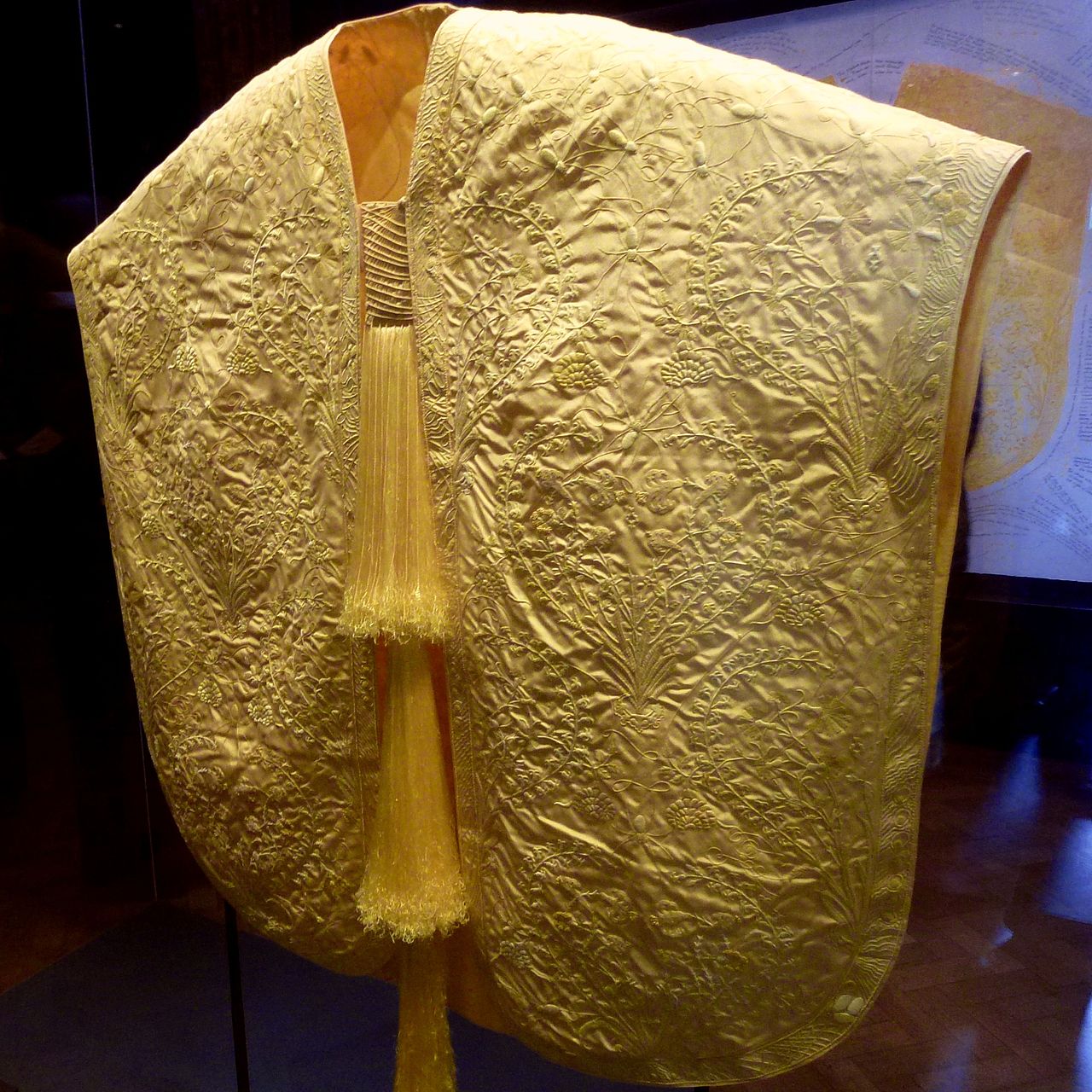
| A cape made from Madagascar Golden Orb spider silk exhibited at London's Victoria and Albert Museum (June 2012). (photo: Cmglee, on Wikimedia Commons).. |
A decade is a long time. In the 10 years since I started this blog, I've seen many costuming blogs fall by the wayside, lost to family obligations, changes in health, changes in priorities, and the rise of other forms of social media, such as Instagram and Facebook. Other Internet communities of historical costumers, including the MedCos list and the Norsefolk and Norsefolk_2 mailing lists on Yahoo!, are defunct, and the h-costume list, though still technically active, sees very little activity now.
On the other hand, Instagram and Facebook bear witness to the fact that there are more historical costumers, and more people interested in historical costuming, than ever. I ended up as one of the moderators of the Reenactment clothing and textiles group on Facebook because they get so many applicants. In addition, I have become concerned that Google will get rid of Blogger, as they have decommissioned G+ and so many other interesting and useful products, and that I will have to migrate my blog to another platform to keep it alive. But I still enjoy blogging, and am determined to continue to maintain an Internet presence through my blogs.
The last time I did an anniversary post, it was 2011. In that post, I included a token link to an actual costume-related article (since an anniversary post is technically a "meta" post). This link I found courtesy of Susan Baker Farmer on the Historic Tablet Weaving Group on Facebook. The article is about gene-modified bacteria that produce a spider silk so strong that space suits could be made from fabric woven out of it. The technique used doesn't produce very much silk, and doesn't produce it efficiently, but if it can be modified to produce at industrial levels it will have created something valuable and new indeed. Enjoy!
P.S. The cape in the picture is made from spider silk, but not the kind reproduced with genetically-modified bacteria. I added it for visual interest, and because it's an interesting garment in its own right.
EDIT: (6/4/2019) Since this post, there has been a concerted effort made by members of h-costume to reactivate the list, so don't hesitate to sign up if you are interested!
On the other hand, Instagram and Facebook bear witness to the fact that there are more historical costumers, and more people interested in historical costuming, than ever. I ended up as one of the moderators of the Reenactment clothing and textiles group on Facebook because they get so many applicants. In addition, I have become concerned that Google will get rid of Blogger, as they have decommissioned G+ and so many other interesting and useful products, and that I will have to migrate my blog to another platform to keep it alive. But I still enjoy blogging, and am determined to continue to maintain an Internet presence through my blogs.
The last time I did an anniversary post, it was 2011. In that post, I included a token link to an actual costume-related article (since an anniversary post is technically a "meta" post). This link I found courtesy of Susan Baker Farmer on the Historic Tablet Weaving Group on Facebook. The article is about gene-modified bacteria that produce a spider silk so strong that space suits could be made from fabric woven out of it. The technique used doesn't produce very much silk, and doesn't produce it efficiently, but if it can be modified to produce at industrial levels it will have created something valuable and new indeed. Enjoy!
P.S. The cape in the picture is made from spider silk, but not the kind reproduced with genetically-modified bacteria. I added it for visual interest, and because it's an interesting garment in its own right.
EDIT: (6/4/2019) Since this post, there has been a concerted effort made by members of h-costume to reactivate the list, so don't hesitate to sign up if you are interested!
