Showing posts with label himation. Show all posts

Thursday, January 16, 2014

Sewing For Byzantium--The Final Adjustment to the Himation

New portion--view from right side (hem at bottom)
I have finally completed the necessary lengthening of the himation to be period-appropriate, and can now consider it truly completed.  Because it's late here and my husband, who doubles as my fashion photographer, is busy, I will add photographs to this post later today.

The technique I used for lengthening the tunic involved unpicking and unfolding the hem, piecing together an approximately 7-inch-wide (18 cm) strip of my leftover green linen that was long enough to go around the entire bottom of the garment, and sewing that strip to the bottom edge, using the same technique of whipstitching folded edges together that I had used on the seams.  Then I hemmed the new bottom edge with a double-foldover hem.

The himation lengthening is my project for HSF 2014 Challenge #1--Make Do and Mend.  The HSF statistics for this project are as follows:

Fabric:   The last scraps of the same linen used to make the himation in the first place.  I had a strip about two-and-a-half feet long and 7 inches wide left of that linen (76 cm x 18 cm) and a much shorter, second scrap of similar width.  I pieced the two together and sewed the result onto the bottom of the existing himation.

Finally long enough!
New portion--view from wrong side (hem at bottom)
Pattern: None needed, though the technique is my own, so far as I know.  Still, the Byzantines probably would have used a similar method if they needed to substantially lengthen a garment after it was completed.  There is art showing the period equivalent of exotic dancers wearing a long dress with a broad ruffle on the bottom.  Such a ruffle would have had to have been sewn on to the dress somehow, and that stitching would need to be sturdy if a woman was wearing it regularly for dance performances.

Year: Still Middle Byzantine, i.e., 10th-12th century C.E.

Notions: Londonderry brand linen thread in Persian green, 80/3.

How historically accurate is it?  Hard to say (until we excavate a garment lengthened in this manner), but existing evidence shows that folk in the Middle Ages were not averse to piecing fabric to achieve the effect they wanted.  (See also my ruffle comment, above).  So perhaps 70-80%.

Hours to complete:  2-3 hours--I didn't keep track very closely.   Some of the time was spent in ironing the piece to make it possible to shove sections that were too narrowly folded to come close enough together to be stitched into an enclosed seam.

First worn:  Not really applicable, since I've worn the garment for photographs after I originally finished it.

Total cost: $0, since all the work was done with materials purchased to make the garment originally.

Now, on to HSF Challenge #2--Innovation, and Yet Another Apron Dress!

EDIT:  [1/26/2014]:  Added a picture of me wearing the lengthened himation to this post.

Sunday, January 12, 2014

Sewing For Byzantium--The Himation Scrutinized

Entire outfit
The himation with shirt
Here is the promised photograph of my himation with the other components of my Middle Byzantine outfit, thanks to my husband's willingness to wield the camera for me. (I will post one of them on the HSF 2013 Challenge #23 page as well.)

Given the incredible difficulty I had making myself focus on this project, it came out very well.  The side slit at the neck closure sometimes gaps open, a little, but I can pin that, and the neckline is a bit high and impinges upon the shirt collar, but I think that will even out as I wear it.

But the himation has one problem that cannot be ignored.  It is way too short.  Even unbelted, a bit of the shirt's calf-length hem shows, as well as the foot to the ankle.  In his writing about Middle Byzantine costume, Timothy Dawson stresses that clothing was unusually modest, and hemlines, even for lower-class women, were very long.  He says that ground length is appropriate, and even if I choose to err on the side of slight shortness for practicality's sake, this tunic should, at the very least, be instep length, not ankle-length--even when belted.  (I didn't have the nerve to see what belting it would do at its present length.) That means it needs at least another 5 or 6 inches of length.

On the bright side, I have quite a few large scraps of the green linen left.  I can cut a suitably-sized strip of the fabric, sew it to the present hem, and hem the new bottom, to lengthen the tunic.  Yes, that's going to be a lot more seam/hem sewing, but it fits in, thematically, with the first HSF Challenge of 2014: Make Do and Mend, and (fortunately, since it's already the 12th and the Challenge deadline is the 15th) that shouldn't take long to do.

So it looks as though I have more work still to do on this project before I can go back and teach myself enough embroidery to ornament the neckline and sleeves.  On the other hand, it's providing the perfect springboard for me to leap into HSF 2014!

Sunday, December 8, 2013

Sewing for Byzantium--A Different View of the Himation

The himation, inside-out.
Close up of side seam and hem.
Now my himation is truly done, and here's a new photograph to prove it. 

The difference here, of course, is that we are now looking at the himation inside-out, with the seams visible.

I've also included a close-up photograph of a part of one of the seams, to help explain how I did it.

What I did was to take the pieces I wanted to join, wrong-sides facing me, and fold each edge over, onto the wrong side of the fabric, by about 1 cm.  Then I whipstitched the pieces together by putting the needle through the edge of each fold.  

To "finish" each seam, I simply folded the raw edges inward, toward the stitched seam, and whip stitched the two portions of the remaining seam allowances together so that all of the raw edges were enclosed.  This isn't really a flat-felled seam, though it wouldn't be hard to make it one (by sewing the joined pair of raw edges down).  It has the virtue that it all can be, and was, done with my favorite stitch--whip stitch! 

The hem was done, as Heather Rose Jones describes in her guide to Archaeological Sewing, with a hem finish typically found on linen garments--i.e., the raw edge was turned twice and hem stitched.

I've tried the himation on, and it fits beautifully, except that it's too short!  It looks as though I'm going to have to add fabric at the hem to bring it to the correct length. I'll explain more when I post photographs showing the himation in wear.

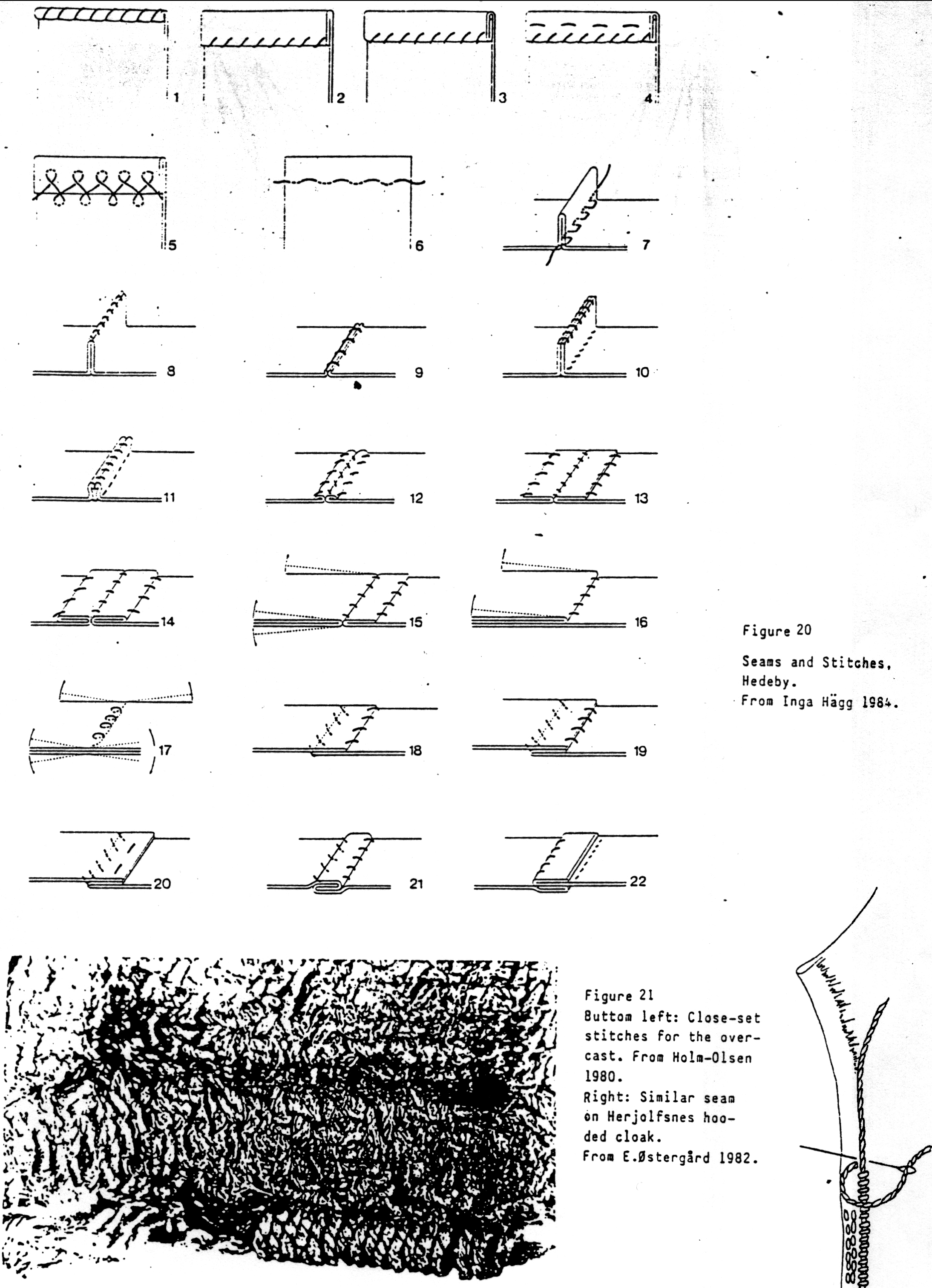
EDIT:  (12/15/2013)  I thought I remembered seeing a historical reference indicating that the type of seam treatment I used on the himation was used somewhere during the medieval period. I found the reference, and although it is not identical to what I did, it is similar. This chart, which I located again via Pinterest, shows stitch types that were found on fabric fragments from Hedeby. Number 10 is close to what I did, except on 10 the initial seam appears to have been sewn with running stitch. 12 appears to use a whipstitch on the folded fabric edges to create the actual seam, but the seam allowances are sewn onto the inner surface of the garment instead of to each other as I have done. Hedeby is not Byzantium, but the existence of so many different ways to make a seam with enclosed raw edges during the 10th century (contemporary with the Middle Byzantine period) suggests that my approach to the seaming of the himation was not necessarily anachronistic.

Monday, December 2, 2013

Sewing for Byzantium: The Himation is Done!

The himation
Finally!  It's done.

Actually, it's not *quite* done. I still need to complete the seam finishing so nothing ravels, and I intend to perpetrate embroidery around the neckline and sleeve-ends at some point. But I may well be able to do the seam finishing tomorrow night, and even now it's wearable. I photographed it on a hanger purely because my husband wanted to go to bed early and I didn't feel like putting on the other garments that go with it (the mantion, savanion, and shirt) for photographs.  I'll do that sometime this week.

Here are the official statistics, as required by the Historical Sew Fortnightly rules:

The Challenge:  #24--Re-do. (i.e., re-do a previous challenge).  As I've said way too many times now previously, my himation qualifies for a number of the previous challenges.  This time, I'm going to list all of the ones for which I think it qualifies:
  • #2 UFO. This is the last necessary component for my Middle Byzantine outfit and I'd been meaning to do it for years now.
  • #5 Peasants and Pioneers. The outfit of which this is one of the most important parts is essentially rich peasant's clothing.
  • #8 By the Sea.  Byzantium (later called Constantinople and now called Istanbul) was a seaport, and many of the Byzantine Empire's provinces were coastal.  
  • #10 Squares, Rectangles, and Triangles.  All early medieval garments are composed of squares, rectangles, and triangles, and this one is no exception.
  • #14 Eastern Influence.  The Byzantine Empire was an Eastern power, compared to the rest of Europe, of course.
  • #17 Robes and Robings.  The neckline and sleeve-ends are trimmed with robings, and one could arguably consider the tunic itself to be a robe.
  • #21  Colour Challenge Green.  Very.
  • #23 Generosity and Gratitude.  I owe a debt of gratitude first to Peter Beatson, whose page on how to make a Manazan shirt inspired me to start making a Middle Byzantine outfit in the first place, but also to Timothy Dawson, whose research, both in print and on the Levantia website, gave me the information to finish it.
Fabric:   Nearly 3 yards of 100% linen, medium weight, in apple green, purchased from fabrics-store.com.  Scraps of the same type of linen in dark blue, from the same source.

Pattern: My own, adapted from Peter Beatson's Manazan shirt pattern and Timothy Dawson's sketches and research.

Year: It is rarely possible to pin down Early Period clothing to a particular year.  My design is Middle Byzantine, i.e., 10th-12th century CE.

Notions: Linen thread, in several different (and not particularly matching) shades of green, 80/3.  Silk thread in dark blue from Gutterman's (for sewing the blue linen around the neck and sleeve-ends). 

How historically accurate is it?  The pattern is as accurate as present research can make it.  It is completely hand-sewn, and at least some of the construction stitches I chose are accurate though I haven't checked very closely.  The colors would be plausible for wool, and the blue was possible on linen (it's pretty close to the blue of the linen apron-dress loop found in the 10th century Pskov grave).  However, I can't document that the particular green I chose for the body of the dress could have been achieved on linen during that period, and there's always the issue of whether linen was used for clothing other than undergarments in period.  So let's say 70%-80%, though that might be wildly optimistic on my part. 

Hours to complete:  5 hours, spread out over almost as many months.

First worn:  Not yet! Hopefully tomorrow or Tuesday for photographs, including photographs of the entire Middle Byzantine outfit.  

Total cost:  Hard to say because most of the costs were incurred years ago and the blue silk thread was originally bought for another project anyway.  If you added up the original cost of the linen thread and the cloth used, it probably comes to no more than $30 USD.

Wednesday, November 27, 2013

Final Sprint For HSF Challenge #24?

The deadline for the next Historical Sew Fortnightly challenge for this year, "Re-do", is December 2.  My intention is to have my himation complete--or at least completely wearable--for that challenge.  So where do I stand?  Can I make it?  Maybe.

Floss colors to embroider the himation.
Last night, I made significant progress on my himation.  The neckline is done, complete with button-and-loop closure and blue linen trim.  Now I only need to close the seams up the sleeves, finish the seams inside, and hem the tunic.  (In a pinch, I'll finish enough of the seams to do the hem, and complete that job later.)  Granted, I don't expect to be able to add more ornamentation to the tunic by December 2, but at least the tunic would be fit to wear by then.

Cross pommee
Even so, time is going to be tight.  Tomorrow is Thanksgiving, which is a significant family holiday here in the US.  I will likely be spending a large chunk of it with my husband's family eating way too much turkey and pie.  I have a meeting Friday morning, and plans to spend the rest of the day at our favorite board gaming store, where there will be an all-day session of board gaming, and I'm committed to meetings most of Saturday.  So that will leave Sunday to finish the tunic proper before the deadline.  Doable?  Probably--unless I screw something up.  

Speaking of ornamentation, I did some looking today and confirmed that cotton crochet thread, even if braided, will not give the look I want.  So I'm going to go with embroidery after all.  To the left is a picture of the colors of DMC cotton embroidery floss I bought--an off-white simply labeled "ecru", a pale blue (DMC #827) and a deep bluish red (DMC #815).

My current thought is to do stem stitch along the side of the blue linen where I originally planned to couch some cord.  On the neckline, I will stem-stitch circles with the ecru floss, to which I will add crosses worked in the pale blue and highlighted with the red.   The crosses would be shaped much like the cross pommee in heraldry, with a red ball at each point of the cross and in the center (shown on the right, courtesy of Wikimedia Commons).  I found a good video on Mary Corbet's Needle and Thread site that demonstrates how to do stem stitch; hopefully I can follow it well enough not to become frustrated. 

It sounds like a workable idea to me, but no plan, whether for sewing or battle, long survives contact with the enemy.  I'll just have to forge ahead and see how it all turns out.

EDIT:  (11/28/2013)  I have a himation.  It still needs finishing (hemming, seam finishing, and, at some point, embellishment) but it's a complete garment.  I expect to be able to hem it, and perhaps finish the seams by Monday.

Tuesday, November 12, 2013

The Himation: A Quick Update

With November 18 (the latest Historical Sew Fortnightly I'm hoping to make) fast approaching, I figured that it's time for another update on my Byzantine tunic (himation) project.

The tunic-in-progress is still essentially a flat piece (though the gores and sleeves are sewn onto it) because I got bogged down in trying to sew my blue linen strips around the neckline.  Part of the problem is that I cut the strips on the straight of grain because I did not have enough blue linen left to cut them on the bias, but another part is the inevitable consequence of trying to fit a broad strip along a sharply curved neckline.  In the end, some tucks (and a non-period steam iron) will be involved, but I will make it work.  At this point, I've gotten the trim about three-quarters of the way around the neck and have sewn it on the sleeve-ends as well.

I have given up on adding the purchased trim to the tunic, not because I can't find it (though in fact I haven't found it yet), but because although the colors of the trim and linen work together, the textures would be all wrong.  The purchased trim is very stiff and tightly woven, and has a very slight sheen.  Texture-wise, it's everything the linen is not, and that would create the wrong effect for the tunic.

So, for now, I'm going to stick with using the blue linen alone as trim.  Later, if I can think of a suitable motif, I might consider adding embroidery even though I haven't dabbled in embroidery for almost four decades now.  The recreated himation on the Levantia web site that inspired this project has a simple embroidered design based upon crosses inside of circles (you can see it in this photograph), but I'm not at all confident of being able to make the crosses or circles symmetrical enough to look good.  If anyone has any alternative suggestions, please comment on this post.  

There's also a question of what kind of thread I should use.  I'd use wool, except I want the dress to remain washable.  That argues for a commercial embroidery floss, or for linen embroidery thread.  I don't have either of those things and I need to keep costs down.  Suggestions on this issue would also be greatly appreciated.

Friday, October 18, 2013

Himation Update

If I'm going to complete my himation (an ankle-length tunic, discussed in earlier posts) for the Historical Sew Fortnightly "Colour Challenge Green," it has to be done by Monday, October 21. Although I'm making good progress, I don't think I'll finish that quickly.  

At this point, I've sewn the basic seams that fasten the sleeves to the body piece, and have one of the two side gores sewn onto the body piece on one side.  To complete the basic construction, I need to sew the gore that's already attached to the other side of the body piece, sew in the second gore, and close up the sleeves.  However, I have not yet cut the neckline, let alone trimmed it or added a bead and loop to close it; I'll probably do that before I sew the other side of the first gore, because until I do that the work-in-progress is still a flat piece of cloth, and it's easier to work on the neckline while the garment is still a flat piece. Then, after the neckline is completed and the body and sleeves are closed up, I'll need to finish the seams inside and hem it.  

I still haven't decided whether to add any of my store-bought trim to the top of the blue linen strips (actually, I still have to find it).  

Unless I spend all of my available time between now and Monday on sewing, I won't finish in time for Colour Challenge Green.  However, the "Generosity and Gratitude" (i.e., gratitude for on-line resources you have used) challenge, due November 18, is very realistic.  I expect to finish well before then, and will have photographs of the himation and the completed Middle Byzantine outfit.

Monday, July 1, 2013

Sewing For Byzantium: Starting the Himation

Fabric for tunic and trim
Tonight, I finally started making the himation, or overtunic, for my Middle Byzantine costume.  It will be a much simpler garment than the shirt, because it will have only a simple round neck with a long slit, and no collar.

I ripped a piece that will be the right size for the body and confirmed that I have enough remaining for gores and sleeves.  I have also torn strips of my remaining dark blue linen from the fitted wrapped apron dress project that I will piece together to form the basic trim.  The photograph below gives an idea of how the green linen that I'm using for the tunic itself will look with the dark blue.  [I can't seem to download the photograph tonight, so I'll have to add it to this post tomorrow.]

Unfortunately, I haven't been able to find the purchased trim I was planning to use on top of the dark blue strips, but because I will be sewing the tunic by hand I should have plenty of time to look for it.

EDIT: (7/2/2013) I have just succeeded in downloading my photograph from the other night (using my Nexus 7, not my desktop machine).  Here it is.  The fabric colors are a bit deeper and richer in reality.

Tuesday, May 5, 2009

Sewing for Byzantium--Himation Design

Now that I have my Byzantine underwear finished, I've been thinking about actually cutting my pretty green linen, in order to make a himation out of it. I plan to use much the same pattern as I did for the Manazan shirt, but with a few modifications.

First, I intend to make the himation longer than the shirt, so that it is at least floor length. (The shirt was ankle length before I hemmed it, but I gave it a generous hem to make certain that it would not show beneath the himation.) I also intend to cut the himation a bit wider than the shirt, so that it doesn't hug my body too tightly when worn over the shirt. As I mentioned, I had to make the gores in the shirt a bit narrower than I intended due to a shortage of fabric; I want to avoid doing that here, since I want the skirt of the himation to have more sweep to it than the shirt does.

In addition, the himation will have a plain round neck, with a slit (probably a very short one, judging from the size of the slit on the shirt) down the left shoulder. To finish the neckline, I plan to retain the square yoke piece, instead of simply cutting a facing for the slit and sewing bias tape or binding around the neck. Because there will be no collar on the himation, I can simply sew the yoke piece to the inside of the body piece, cut the neckhole in the body piece using the hole I've cut in the yoke piece as a guide, turn the edges inward on both yoke and body piece, and whip stitch around the opening. Since the collar of the shirt will protect my neck, any roughness due to the whipstitching shouldn't be a problem.

My only real concern is the trim. It is purest polyester (though with a great design!) and rather stiff in texture; I'm not sure I'll be able to get it to conform to a round neckline. Experimentation will be in order.

Wednesday, March 25, 2009

Sewing for Byzantium--Planning the Himation

My himation will be the same pattern as the Manazan shirt I'm finishing, but without the front slit and collar. It will be made from a heavy-weight linen in a delicious shade of green, courtesy of Fabrics-store.com, shown on the left. I bought the trim shown on the left from an EBay vendor who trades under the name "Celtic Trims." I plan to use the trim doubled, sewing two lengths together (with the checkered border on one piece folded underneath) so that the result looks like a border of flowers inside a row of diamonds--a design that is vaguely like a period embroidery design I've seen in one of Timothy Dawson's monographs on Middle Byzantine costume. A picture of the trim appears above. It is a bit over 1 inch (25 cm) wide.

Because the neckline on the himation is supposed to be round, and is supposed to lie neatly right up against the bottom of the shirt collar, it will have to be small enough to require a slit, and a button and loop to close it. I plan to buy some blue cord to make a button and loop from, and the slit will extend onto the left shoulder to be camouflaged by the trim around the neck. I also plan to acquire green linen thread to sew the himation with. (I already have dark blue thread I can use for sewing strips of the trim together, and also for sewing the trim to the garment, if using blue thread turns out to be less obtrusive for the purpose than using the green thread would be.)

There will be photos, once I have gotten far enough along to have something to photograph.