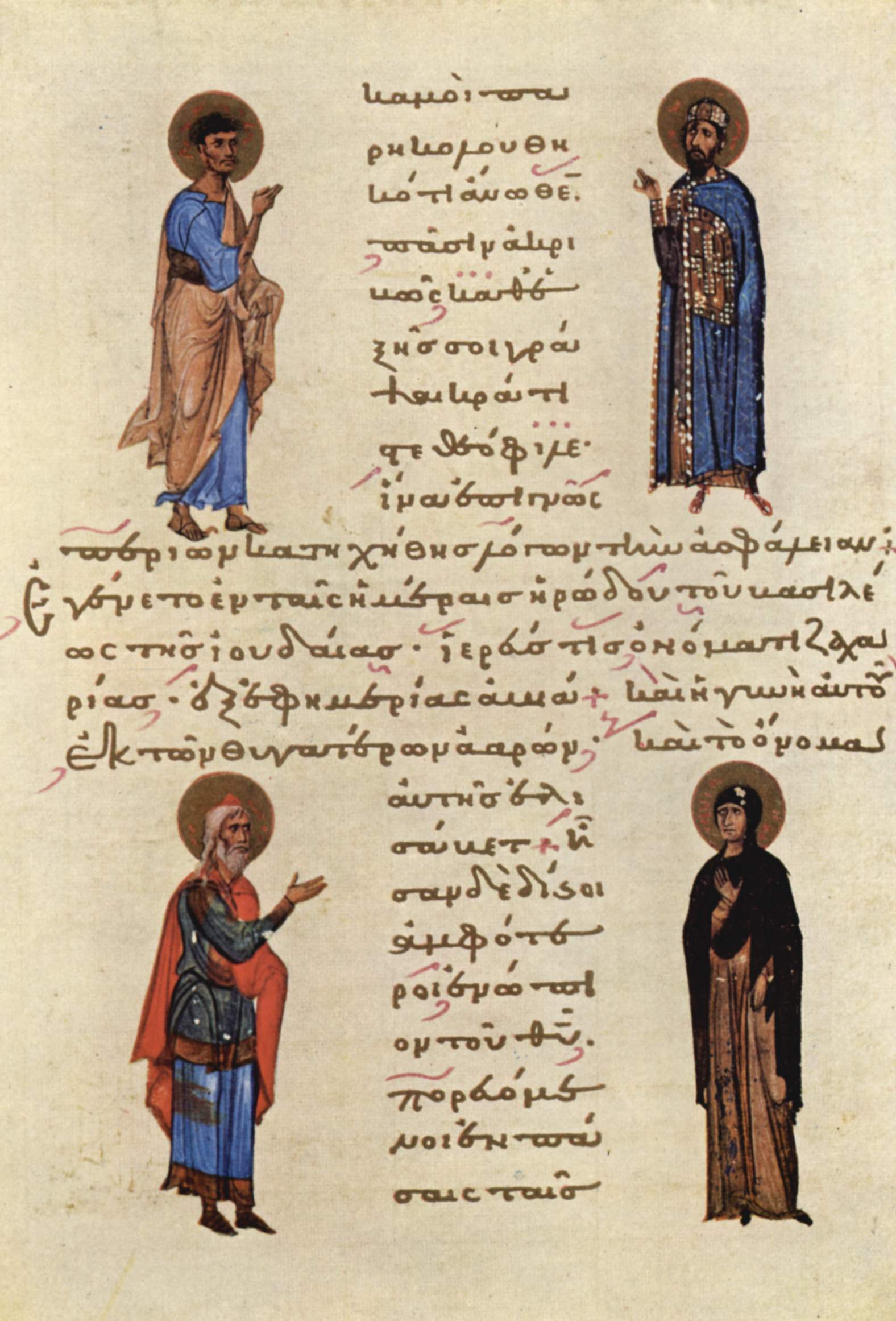
I have been thinking about the cloak that I need to make for the völva costume. My assumption, based upon other surviving garments of the same period and upon the description in Eric the Red's Saga (e.g., the fact that the völva's cloak has "straps") is that this cloak should be a semicircular cloak. However, my last attempt to make a semicircular cloak, the Byzantine mantion I made some years ago, fits poorly and is hard to keep in position in wear.
I suspect, on the basis of the shapes of the surviving semicircular cloaks from the Viking age, that the fact that my mantion fits poorly does not mean its design is anachronistic. Far from it; I'd bet that most semicircular cloaks in the early Middle Ages fit poorly, because a simple semi-circular design fails to take the protuberance of the shoulders into consideration. It occurred to me that, if I want the cloak to be secure when simply tied on with long straps, I must do something about the shoulder problem. I would like to experiment with techniques that might make this cloak fit better, even if such techniques are not documentable to the Viking age.
One possibility would be to shape the relevant area of the cloak to my form with seams, stitched on the inside of the garment. That could be worked out by pinning the seams first to check for fit. I'm thinking that a few seams, radiating outward from (roughly) the center of the neck notch and reaching downward about 6 inches may work. In that case, it might be possible to achieve a decent fit with a simple circular neck-notch.
The idea would be to cut the neck notch and sew the fitting seams first. Finishing the neck could be simple. I am thinking of cutting a long piece of silk, a bit more than twice as wide as I want the "straps" to be. The idea would be to use the strip to bind the neckline by placing the center of the silk strip against the back center of the neck notch, fold the fabric over each side of the neck notch, and stitch it down around the neckline. (Yes this will take some folding and tweaking, but might be worth it.) Then stitch down the rest of the length of each strap, fold the edges inward and stitch together along the folds. In other words, the silk strip would be fastened to the cloak all around the neckline, and the rest would serve as long straps. That way, the straps would be unlikely to rip away from the cloak. The sketch to the left above should give a better idea of what I mean. (N.B.: The two different pieces are not drawn to the same scale.)
This concept assumes, of course, that my piece of fabric is large enough to cut the cloak as a semicircle; I don't recall exactly how big it is. If the fabric is not wide or long enough, it may make better sense to try to cut the cloak as a series of pie-shaped wedges and stitch them together to create a better-fitting shape.
If anyone has comments or thoughts about these ideas, please let me know in the comments.
The idea would be to cut the neck notch and sew the fitting seams first. Finishing the neck could be simple. I am thinking of cutting a long piece of silk, a bit more than twice as wide as I want the "straps" to be. The idea would be to use the strip to bind the neckline by placing the center of the silk strip against the back center of the neck notch, fold the fabric over each side of the neck notch, and stitch it down around the neckline. (Yes this will take some folding and tweaking, but might be worth it.) Then stitch down the rest of the length of each strap, fold the edges inward and stitch together along the folds. In other words, the silk strip would be fastened to the cloak all around the neckline, and the rest would serve as long straps. That way, the straps would be unlikely to rip away from the cloak. The sketch to the left above should give a better idea of what I mean. (N.B.: The two different pieces are not drawn to the same scale.)
This concept assumes, of course, that my piece of fabric is large enough to cut the cloak as a semicircle; I don't recall exactly how big it is. If the fabric is not wide or long enough, it may make better sense to try to cut the cloak as a series of pie-shaped wedges and stitch them together to create a better-fitting shape.
If anyone has comments or thoughts about these ideas, please let me know in the comments.