Showing posts with label shift. Show all posts

Saturday, July 3, 2021

One Afternoon Tutorials--Underwear

Sketch of a chemise, by David Ring.
Found on Wikimedia Commons
Having covered almost every other type of quick costuming project, I come to what is perhaps the most basic category of all:  one-afternoon projects about underwear.  

Underwear is the layer of clothing closest to the body.  It includes shifts for women (also called chemises), breast bands and bras, men's shirts, loincloths (wearable by either sex though usually associated with men) and equivalents of what Americans now call "panties" for women.  Before the 20th century, underwear was most often made of linen in Europe and America, but in modern times it's usually made from cotton or cheap synthetic fabric worldwide.

Until at least the end of the medieval period, stockings and socks arguably qualified as underwear under the above definition, because they typically were not made to be seen.  However, stockings and socks require special fitting and design, which is why they are not included here, though some stocking projects can be as quick to make as the items discussed below.  Corsets are also underwear, but because they require way too much detail work to be a one-afternoon project, I will not include them here either.

NOTE:  A man's shirt or woman's shift likely will take longer than a single afternoon to make (even during the summer) if completely handsewn.  If one cheats by using a sewing machine, it should be doable in one afternoon, as it involves mostly long straight seams.  For that reason, I have included shifts and shirts here.

As always, unless I have said otherwise here, I have not made any of the items in this collection of tutorials myself.  

Breast Support: 
  • Mammilare or Strophium:  These are Roman terms for a simple band to constrain and support the breasts.  The simplest form is a long, narrow rectangular piece of fabric, ripped along the grain to provide a straight though unhemmed edge.  This website shows a very basic one made from wool, whose natural stretch would make it a good choice for folk who do not get an allergic reaction after wearing wool against the skin.  See it here.  (Frankly, I'm surprised to find this post still available on the Internet, since I first discovered it more than two decades ago.)
  • Late Medieval "Supportive" Smock:  This is a kind of smock that is cut to provide some support for the breasts.  Elena of Neulakko explains its use, as well as how to make one, here.

Men's Shirts: 

  • Early Modern Shirt: The Costume Historian provides this tutorial, which is suitable for the period from roughly 1530 to 1660 CE.
  • Regency Era Shirt:  The Tea In A Teacup blog provides an illustrated tutorial as to how to make a shirt from the Regency (roughly, the early 1810s to the early 1820s).   You can find that tutorial here.  
  • 18th Century Shirt:   From La couturière française comes a genuine shirt tutorial and pattern from the mid-18th century, with clarifying text from the owner of the web site.  Potentially a lot of fun, if you have the right mindset and skills.  
Women's Shifts and Petticoats:  
 
Shifts did change in design, slowly, over time.  Early medieval shifts were fairly wide through the body, with long sleeves and a neckline matching the neckline of the gown under which they were worn.  Later medieval shifts could be sleeveless as they were often worn under form-fitting gowns.  Renaissance shifts (such as the Venetian camisia below) were extremely wide, both in the body and sleeves, and were gathered with tiny gathers into a band that usually matched the neckline of the gown with which they were to be worn. 18th century shifts could have three-quarter-length sleeves and were quite short.  19th century shifts were short-sleeved or sleeveless, about knee-length or came just below the knee, and were finally replaced with "combinations"--which were closed with loose legs on the bottom.  Below are some examples of tutorial on how to make a sampling of female undergarments through the ages:
  • Viking/Early Medieval:  It is believed that these garments were shaped just like an ordinary gown or robe, but were often made of linen and worn underneath one or more garments. (The Viborg shirt, a male equivalent, is too complicated to be a one afternoon job.)  They can be made quickly if done anachronistically with a sewing machine; handsewing them, though a simple matter of making many long straight seams, takes much longer.  Handsewing History has a well-illustrated tutorial about how to make such a garment, here.  
  • Byzantine (10th century):  Peter Beatson's pattern for a Byzantine undershirt is based upon an actual archaeological find, the Manazan shirt, on display in a Turkish museum.  This style may have been worn by both men and women; the gender of the wearer of the Manazan shirt is, to my knowledge, still debated. NOTE:  My Manazan shirt, which I wrote about in several different posts starting here, used Beatson's original proposed pattern, which his page now explains was probably erroneous.
  • Venetian Camisia (16th century): Shown for informational purposes, though handling the fine gathering is more easily done by hand and probably takes the end result out of the range of a one-afternoon project.  Bella's Realm of Venus site includes a tutorial here.   I have also found an "easy to wear" version that's a bit less thoroughly historical, where the construction seams were sewn by machine, though the gathering was still done by hand. 
  • 18th Century Shift:  Like medieval shifts, these are made from geometrically shaped pieces of fabric and connected with straight seams.  Mara Riley's tutorial explains the technique and gives supporting sources and suggestions for obtaining needed supplies as well.  Find it here.    
  • 18th Century Petticoat:  Petticoats were worn from the Renaissance through the end of the 19th century. Construction does not change much; these are essentially a quantity of fabric pleated or gathered onto a waistband.  Since the waistband is never when the garment is worn, how you make the petticoat matters less than the type of fabric you use and the length of the garment.  Try this tutorial from the American Duchess website.   
Men's Underpants:
  • Loincloths:  People living in cultures who do not wear any other clothing often wear loincloths.  The simplest form of these requires a cloth about 18 inches wide, which is wrapped around the man's waist at least twice.  The hanging end is then brought between his legs, from back to front, tucked into the wrapped portion, and allowed to hang over the wrapped portion in front.  This website, which discusses loincloths worn in Borneo, also gives a surprisingly good tutorial on how to wrap a "generic" loincloth, here.   
  • Dhoti:  The dhoti is a wrapped, lower body garment worn in India.  It may be short or long. It's essentially a loincloth with pleats used to control the extra fabric, and thus comes farther down the legs than a loincloth does.  This page provides a useful tutorial, with sketches, in how to shape and drape a dhoti.  NOTE:  The page is not in English, but the drawings are clear and easy to understand.  It even includes a video! 
  • Braies:  This article (in both Finnish and English) suggests that the type of knee-length underpants shown on men in European medieval art could have been made by draping, belting and tying a suitably-sized piece of cloth.  The technique is speculative, but would make for a very quick project indeed!
  • Civil War (Men's) Drawers:  More complicated than a loincloth, but still reasonably simple.  This link will take you to a blog which explains the construction and includes an image of the original pattern, which should be sufficient for some people to reproduce such a garment, though it's not a project for a beginner.
Women's Underpants:  

Until the Renaissance, women do not seem to have worn underpants, at least not after Rome fell.  There is some evidence for the use of a garment by Ancient Roman women called a subligaculum. (However, it's possible that the bikini-type garment shown in this ancient Roman mosaic by women engaging in physical exercise was not worn anywhere other than in a physical exercise context.) 

From the Realm of Venus page we have an illustrated discussion of the evidence for long (knee-length) drawers being worn by at least some Italian women during the Renaissance.  

I have not hunted for free tutorials in this category because there is no consensus about the shape of Renaissance-era underpants, and commercial patterns are easily available for many later period undergarments.  If I find additional tutorials on female undergarments, I will write another post on this subject.  

Do your own research if the maximum possible historical correctness is your aim, but whatever else you do, have fun!

Thursday, June 16, 2011

The Bending of the Pleats

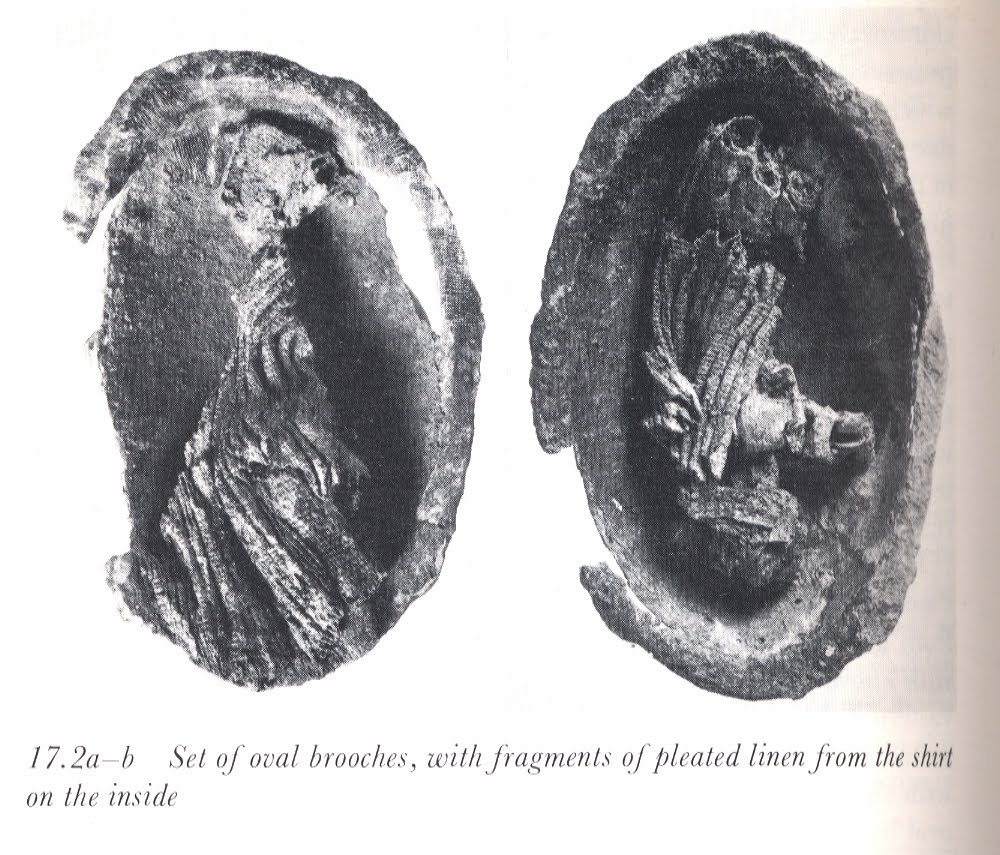
Last week, while I was re-reading Hilde Thunem's essay-in-progress about Viking women's shifts yet another time, I had a revelation about the evidence. Specifically, my revelation was about the fragments of tightly pleated fabric, believed to be from shifts, that were found inside many tortoise brooches at Birka. 

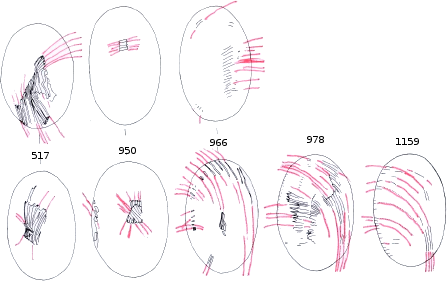
Ms. Thunem notes in her essay that the pleated fragments usually bend in one direction or another. She regrets the fact that Hjalmar Stolpe, who originally excavated those graves, did not take note of which brooch was found on which side of the body:  "This means that there is no way of identifying the left-hand and right-hand brooches, and consequently no way to learn whether the bending of the pleats always pointed towards the shoulders, always towards the throat or differed from one serk to another."

When I first read the essay, I agreed with her sentiment.  But now I wonder whether the fact that the pleats show a bend is sufficient information to  allow us to deduce one more element about how those shifts were made. 

Neckband pleated shifts
Think of the problem this way.  How many different ways are there to pleat a shift? One approach, surely, is to pleat the entire width of the garment to the neckband, as the Pskov shift must have been made. Probably additional work would need to be done to ensure pleats as deep and tight as in the fragments found in the Birka brooches, but the direction of the pleats would at least be determined. As can be seen from the picture to the left from the Adamklissi monument, which depicts a shift pleated to the neckband (though with some puzzling pleats on the short sleeves), the pleats in the area of the upper chest where the tortoise brooches likely appeared would tend to bend toward the centerline of the body, away from the shoulders.

How else might the shifts have been pleated?  In theory they could have been pleated horizontally, with the pleats running across the torso, but it's clear that they were not pleated in that manner, because as Ms. Thunem notes, "there seems to be a tendency for the pleats to run in parallel with the needle in the brooch, and then bend towards one side of the brooch." If the shifts were horizontally pleated, that would not be the case--the pleats inside the brooches would be perpendicular to the needles in the brooches instead.  So it's clear that the pleats on the Birka shifts ran down the torso of the wearers, instead of across it, a pleating direction I'll refer to in the rest of this essay as "vertical" pleats.

What other ways could the shifts have been pleated, other than to a neckband, that would result in vertical pleats?  If those methods would not be likely to result in vertically pleated clumps inside the tortoise brooches, those methods cannot have been used.

I can think of three methods other than the neckband method of pleating a shift.  One is simply to pleat the shift, which is cut with a round or keyhole-style neckline, across its entire width.  This is the method the Historiska Museet used in its Viking women's costume reconstruction.  A variation of this approach would be to pleat the shift from the edges toward the center, starting at the shoulders. However, a tortoise brooch, placed on the relevant upper chest area, would not show any bending of the vertical pleats.

The second possibility is to permanently pleat the body of the shift, perhaps even stitching the pleats down, from a particular point on the torso, such as just above the nipples.  In that circumstance, whether any pleats at all would even show would depend upon the point at which the pleats started.  With this design, pleats would not appear in the brooches at all unless the line of pleats started at the armpit level; the neckline would make it challenging to start them higher.

Faltenklied tunic/shift
The third possibility is to pleat the shift from the shoulders, as above, but with the pleats running diagonally toward the shoulders and the centerline of the body, like the Faltenklied figure on the Adamklissi monument, shown on the right. Pleats based on this model would accordingly show a bend outward, toward the shoulders.

However, there are other factors that make the Faltenklied type of pleated garment unlikely to have been the model for the finds at Birka.  The Faltenklied figures are plainly men, not women; men from the Roman era, not the ninth and tenth centuries CE like the Birka women.  On the other hand, the neckline pleated shifts of the Adamklissi women are similar to the Pskov shift remains from the tenth century--remains that are linked by the appearance of tortoise brooches to the Viking world.  

So maybe the mere fact that the Birka brooches contain shift fragments with pleats that bend is sufficient evidence to get us a bit closer to a shift design for the Birka women.  Although we don't know, and will never know, whether the pleats any of the brooches pointed toward or away from the occupant's shoulders, the Pskov shift evidence makes it a little more likely that any shift with bending pleats was pleated to a neckband, with the pleats bending toward the shoulders.

By the way, the bending of the pleats is fairly strong evidence that Annika Larsson was wrong about Viking women wearing their brooches directly over their nipples.  If, for example, the Birka women had worn their brooches in such a manner, the pleated fabric remains would have been straight, and would not have bent in either direction, since in any of the shift models that come close to matching the brooch finds the pleats run straight up and down that far down on the body.  This is made clearer by the fact that Larsson uses a shift pleated to a neckband like the Pskov find in her reconstruction costume; the photograph clearly shows that the pleats lie straight over the near-waistline location where the brooches rest.

Saturday, February 26, 2011

Viking Shifts--The Problem of the Sleeves

I've been reading Hilde Thunem's updated article on Viking women's shifts, and it reminded me of another issue that perplexes me; the issue of the sleeves.

Here's the problem.  At Birka, there are a number of 10th century finds in women's graves of pleated linen undergarments.  Most of those finds involve small portions of very finely pleated material, either inside a tortoise brooch, or preserved along the blade of a knife or shears.  Thus,  scholars, costumers and reenactors have generally assumed that the garment, which likely was a shift, would have been pleated by folding the pleats, basting them in place, wetting the garment, and then allowing it to dry before removing the stitching.

There lies the question.  Would the sleeves  of these shifts have  been pleated as well?  If they were, would the sleeves have been pleated in the same direction as  the pleats in the body of the garment?

The Historiska Museet's reconstruction shows the sleeves as having been pleated in the same direction as the body of the shift--that is, vertically, down the body of the garment.   You can see pictures and their write-up (in Swedish) here.

The Historiska Museet's shift reconstruction, however, assumes that any other garments that were worn over the shift (such as an overtunic and an apron dress) were graduated in length so that the pleated parts of the shift show prettily at the hem and at the sleeve-ends.  Though the result is extremely attractive, there is no corroboration whatsoever, either in the art or the period finds, for such a reconstruction.  (Though there isn't any evidence that Viking women didn't wear clothes with graduated hems and sleeve ends to show off pleats, either.)

So what is the evidence that the sleeves of the Viking shifts were pleated?  As I understand it, there are only three categories of evidence for the arms of Viking sleeves, and all are annoyingly indirect.  1)  Some of the Scandinavian graves where tools such as shears were found near the arm of the skeleton have crusted, pleated textile remains on them.   2)  The Adamklissi monument shows at least one Slavic woman in a round-necked, pleated shift with pleating down the length of the very short (i.e., modern t-shirt length) sleeves.  3) the pleating fragments found in the Birka tortoise brooches generally bend, in one direction or the other; it's not known which side each brooch was found on, but it's possible the pleats bend toward each shoulder, which may support a pleated sleeve theory.

With regard to the grave find evidence, Ms. Thunem's essay notes that there are four graves at Birka with pleated remains at a level that could indicate that they are sleeves.  In one of those graves, the pleats are running perpendicular to the arm--and the position of that fragment in the grave is such that the linen is fairly likely to have come from a sleeve.  That makes some sense to me, since it would be easier to pleat a narrow portion of a garment such as a sleeve from the cuff upward (resulting in pleats perpendicular to the arm) than it would to pleat it. parallel to the body.  However, only that find appears to indicate perpendicular pleats, and other such finds could be from the body of the garment instead from an arm.

Short sleeved shift

"Faltenklied" shift
The Adamklissi relief sculpture is equally ambiguous.  showing Slavic shifts.  The one Slavic shift for which I know we have physical evidence, had silk sewn on the flat cuff ends--indicating that the sleeves of that garment were *not* pleated, even though the neckline was, at least, pleated to a band.  The Adamklissi monument shows two kinds of sleeves; short tailored sleeves (image on the left courtesy of Wikimedia Commons) and full, draped or "Faltenklied" sleeves (image on the right, original also from Wikimedia Commons).

The sculpted relief showing short-sleeved shift depicts the pleats running over the top of the shoulder, in a manner that suggests that the sculptor was not working from life, or even from a memory of what pleated sleeves look like, but sculpted them that way because he knew the shift was "pleated." This  theory is supported by the fact that a pleated sleeve, if made wider than a conventional straight sleeve, would flare outward and would not hug the arm the way the sleeves on the second shift does.  On the other hand, if the sleeve was not made wider than a normal short sleeve, the pleats would tend to flatten out and, once exposed to body warmth and pressure, would be gone in no time--assuming that the presence of the pleats didn't make the sleeve too narrow to get the arms through.

I believe there are even more problems with using the "Faltenklied" shift  as a potential model for the pleating style of the Birka shifts or other Viking era shifts.  First of all, it's clear that the Faltenklied-wearing figure is a man--he has a full beard and a thick mustache.  The monument itself suggests that women wore a different garment, for which the Faltenklied figure would not be a model.  Second, the Adamklissi monument was built in 109 C.E., when draped clothes were still the predominant dress in Europe.  Unlike the woman's short-sleeved shift I've shown above, which is similar to shifts that were worn into later times (i.e., the Pskov shift), there is no evidence that anyone was still wearing draped, sleeveless garments, either as outerwear or otherwise, by the ninth and tenth centuries C.E. (the Viking age).  Third, and perhaps more importantly, it's by no means clear from the sculpture that the draping on the arm and the draping over the shoulders were part of the same garment.  It could also be that the garment over the shoulders was a sleeveless tunic, of the type men wore in classical times, and the pleating over the arm was part of a cloak or other outer garment that was draped partly over the shoulder and partly down the arm. 

As for the pleats inside the brooches, the finds indicate that the portions of the garment inside them were some distance from the arms and much closer to a neckline that may well have featured a neckband stitching pleats in place.  Without any indication as to whether the pleats pointed toward or away from the shoulder, it's difficult to make any inferences as to what these pleats say about the nature of the sleeves.
My belief, at this point, is that the pleated shifts generally did not have pleated sleeves, even if the body of the garment was pleated.   I've said before, I think the Slavic sleeves were pleated, perhaps very finely, to a neckband, and any pleats in the body radiated from the neckband.  However, it's also possible that the only permanent pleats were those sewn to the neckband; owners might have chosen to pleat the remainder of the body by basting in pleats with temporary stitches, pulling the pleats tight, wetting the garment and letting it dry to "set" the pleats before removing the thread.  If that was how it was done, the result would be a garment that one could wear with a full set of pleats for special occasions, but it might also be worn without pleating the rest of the garment because the neckline pleats were permanently fixed. 

A pleated long-sleeved shift becomes much more practical if one makes the garment with plain, straight sleeves and confines the pleating to the body of the garment. The existing evidence doesn't strongly indicate that the sleeves of the Birka shifts were pleated, and the Pskov shift seems to have had a pleated neckline and straight sleeves (the find included two deep cuffs, red silk on a blue linen similar to the neckline).

Of course, there may be evidence of which I am ignorant, or have overlooked.  If that is the case, I hope that one of my readers will enlighten me.

Thursday, September 30, 2010

A Minor Mystery

In my few spare moments, I sometimes re-read sources on Viking costume in the hope of having an inspiration that will enlighten me about an issue, or that will motivate me to embark on a new area of research.   So far, I haven't had much in the way of inspiration, but I have stumbled across a question or two.
 
Tonight, my question involves Birka grave 597.  I can best explain it by recourse to pictures.  The first picture, taken from Inga Hägg's article in Cloth and Clothing in Medieval Europe about the Birka finds, is a reproduction of Hjalmar Stolpe's sketch of Grave 597 when it was excavated.  Note that the iron scissors are shown, blade tips pointing downwards, between the two tortoise brooches.

The picture to the right, which is from the same article, shows "iron fragments from the scissors"  found in grave 597. They are covered by linen fragments. The pleats referenced in the caption appear to extend down the long axis of the fragment. However, it's difficult to tell how wide the large fragment shown in this picture is, or what part of the shears the fragment was associated with.  That makes it difficult to discern whether the pleats run in vertical rows, parallel to the length of the shears, as most people believe the shifts in the Birka graves were pleated.

The last picture, still from the same article, shows a textile fragment on iron scissors.  Again, the scale of the fragment is not given.  Hägg's article suggests that this fragment is also from Grave 597; indeed, it could be a larger picture of the fragment shown on the left in the photograph above. The pleats are clear, and run perpendicular to the long dimension of the fragment.

Here's where the mystery lies.  If the linen shift worn by the woman in Grave 597 was pleated so that the pleats ran parallel to her height, any fabric fragments caught on the iron scissors should run parallel with the length of the scissor blades, since the scissors were found with their tips pointing down toward the woman's feet, parallel to her torso.  Yet the fragments look as though they may have covered the entire length of the scissors--or at least their blades.  If that is the case, the pleats may have run perpendicular to the length of the scissors, which would mean the dress was pleated horizontally.

So is it too strange to consider that at least one of the Birka shifts may have been horizontally pleated?  Or is it more likely that the fragment shown in figure 17.35 from the Hägg article was small, only about as wide as the iron scissors?  In that case, the pleats really are running in the expected direction.

Monday, April 26, 2010

The Pleated Birka Shifts--Another Thought

I was going to add this observation onto my previous post about the evidence of pleated shifts found at Birka, but figured that if I did so, no one was likely to see it or comment upon it.

Shelagh Lewins's reconstructed apron dress based on the Køstrup find has given me another thought about the pleats found in the Birka brooches. Her dress uses loops in the back that are as short as the loops in the front. One practical consequence of this design feature is that the dress rises very high in back and is unlikely ever to shift significantly in wear. Another consequence of this feature, however is that her brooches rest very high on her chest--even closer to the neckline of her shift than mine are, as this photograph of her shows, and well within the area of the deepest and densest pleats on a full shift pleated into a close-fitting neckband.

I don't think all apron dresses were made this way, since it seems unlikely that an apron dress made in that manner would be unlikely to turn upside down on the body, as Bau noted some of the brooches found at Birka appear to have done. But some of them might well have used short loops and been worn just as Shelagh suggests.

Sunday, April 11, 2010

The Pleated Birka Shifts

Recently, I obtained a copy of the following article by Flemming Bau describing his theories about what the Viking age women buried at Birka were dressed:
Bau, Flemming. "Seler og Slaeb i Vikingetid: Birka's Kvindedragt i nyt lys." KUML at 13-47 (1981). [The title translates as "Straps and Trains: Birka's Female Costumes in a New Light."]
As I have mentioned in this blog before, Bau believes that the Birka graves provide evidence for the wearing of apron dresses with an opening in the center front, over which an apron (or "front cloth") might be worn in front and a kind of cape with a train (or "back cloth") might be worn covering the woman's back. His evidence in support of these ideas is interesting, and I will discuss it in another post. What I want to discuss in this post, however, is an insight I had about the pleated Birka shifts while reading Bau's article. Although I don't read Swedish  (or Danish, which, as one of my readers observed, the article actually is) very well, the article includes an English translation for all of the captions on the illustrations and charts, and provides a detailed English summary. Examination of the information provided by the summary and illustrations has made me rethink what I believed I knew about the evidence of pleated shifts found at Birka, and what that evidence may be telling us about how those shifts were made.

Although it isn't the primary focus of his article, Bau discusses shifts because he believes that linen imprints found on textile tools that hung from the tortoise brooches of some of the women in the Birka graves provide physical evidence that the apron dresses must have been open in the front.  As a tangent to part of his discussion, Bau notes that the "pleated" Birka shifts (as opposed to the unpleated "plain" ones) may have looked like the shifts seen on women in Russian folk costume.  He provides an illustration from Max Tilke of such a costume, which I have reproduced on the left.  It shows a woman wearing, among other things, a full-bodied shift pleated to a closely-fitted neckband.

Now, there is seldom justification to assume that an item of clothing that was worn as folk costume in the 19th or early 20th centuries C.E. was worn significantly earlier in time.  However, there is evidence for wide shifts pleated to a neckband being worn in the Slavic areas of Europe much, much earlier in time than the Viking age.  For example, the shifts shown on Slavic women on the Adamklissi monument (discussed in this recent post of mine) also are full cut shifts pleated or gathered to a narrow band that fits closely about the neck.  A picture of the Adamklissi shifts, found on Hilde Thunem's webpage about Viking underdresses, appears on the right.  (If the page does not come up, as sometimes occurs, try Google's cached version here.

In addition, there is physical evidence of at least one costume that featured a pleated neck shift with an apron dress--that is the 10th century Pskov find.  The Pskov find has been dated to the 10th century C.E., as have the pleated shift finds at Birka.  A picture of the neckline from the Pskov shift that I have reproduced from the NESAT X article about the Pskov find appears on the left. So we have evidence that women in the Slavic/Russian areas wore loose shifts that were pleated to a close-fitting neckband at least as early as Roman times, and that such shifts were worn in the Viking age. 

Archaeologists, starting with Agnes Geijer, theorized that the pleated shifts for which evidence turns up in the Birka graves were imported from the area we now think of as Russia. For a long time the archaeologists and reenactors have speculated about how these shifts must have been made and about what parts of the garment were actually pleated.  To obtain information about this issue, the pleated linen remnants found inside tortoise brooches can be very useful.

On the right is a photograph taken from Inga Hägg's article  in Cloth and Clothing In Medieval Europe which shoes of the inside of a pair of tortoise brooches that were found at Birka.  I have no information to indicate the scale of the pleating in these brooches, but they do not seem to be so much finer than the pleating around the neckline of the Pskov find.  Notice that the pleats appear to bend to one side.  To the left of this paragraph  is a series of sketches that appear in Hägg's article (apparently reproduced from Stolpe's original excavation sketches), illustrating the way the pleats bend to one side or the other. In her web article about Viking age shifts, Hilda Thunem observes, that it is unfortunate that Stolpe did not indicate on which side of the body each brooch was found. "This means that there is no way of identifying the left-hand and right-hand brooches, and consequently no way to learn whether the bending of the pleats always pointed towards the shoulders, always towards the throat or differed from one serk to another." I agree with Ms. Thunem that Stolpe's failure to record on which side each tortoise brooch was found is unfortunate, since that piece of information would help confirm or refute the theory I am about to describe.

The pictures of shifts that are pleated to a neckband show that the highest concentration of pleats appears within the first few inches from the neck.  The farther down the body one moves, the shallower the pleats become, until by the time you reach the waistline or so  the fabric is no longer pleated, as we see in image of the women in the Adamklissi shifts.  Below this paragraph, to the left, is a cropped picture of me, wearing a simple apron dress over an unpleated linen shift.  The photograph shows that the brooches fall in the area where the highest concentration of pleats are found in the Adamklissi image and the Tilke picture of a woman wearing a pleated shift with folk costume. Admittedly, some women wear their brooches at a lower level on their bodies than I do, but enough grave finds indicate that tortoise brooches were worn close enough to the neck that my practice of wearing the brooches this high was not uncommon.   (I've included Stolpe's sketches  of two of the Birka graves from the Hägg article to further illustrate this point.)

My hypothesis, based on the images and information discussed above, is that Geijer and those who agree with her was correct when she theorized that the pleated Birka shifts were imported from Russia.  However, if my theory about how the Russian shifts were made is correct, those shifts were not pleated through the entire body and sleeves, and they were not pleated by wetting them and using a broomstick-pleating or similar method.  Instead,  my hypothesis is that the shifts were pleated at the neckline, where the pleats were permanently held with a sewn-on neckband.  The reason we see pleated linen inside some tortoise brooches is that the brooches were worn close enough to the neck that they lay on top of the pleated areas--and perhaps were even pinned through them.  The rest of the garment would not need to be pleated for this to occur.   In other words, the idea of the completely pleated linen shift  may be a misapprehension which has arisen by the fact that we only have fragments of shifts from the graves.  Under this view, the Birka shifts were still luxury items, but they were luxury items because they used more cloth than a plain shift (made, perhaps, with rectangles and triangular gores) did--not because they had to be pleated again after each washing.

Hägg's article includes a picture of a pair of scissors found in Birka grave 597, which is reproduced at the right.  Part of the pleated linen has adhered to the scissors.  Note that the pleats appear fairly deep.  However, this fact does not necessarily indicate that the entire body of the shift worn by the woman in grave 597 was pleated.  The scissors in grave 597 were found high on the body, between the brooches, as the diagram from Bau's article, included below this paragraph, shows.  More specific information from the Birka finds to ascertain whether there are any graves containing scissors with pleated  linen remains that were found in a position low on the body, since such evidence would tend to disprove my hypothesis.

If my hypothesis is correct, it answers one of my questions about whether the Pskov shift should have gores.  The answer would be that the Pskov shift would not have had gores.  The body of such a shift could be made by sewing together rectangular pieces of fabric to form a wide tube, and then pleating the top of the fabric into a neckband.  That method, which would produce a result consistent with the Adamklissi image, would make the shift more than wide enough that gores would be superfluous.  My hypothesis would also eliminate the need to posit that the shifts were broomstick pleated, and then re-pleated every time the shift was washed, since pleats made at the neckband would be permanently sewn in place. 

There may well be responses to some of the points I've raised above.  If any of my readers knows of any facts that either support or refute the points I've made above, I would like to hear from you.  It would be wonderful to build a coherent theory as to how the pleated shifts of Birka were made.

Tuesday, March 30, 2010

Rethinking The Pskov Shift

Today, I was thinking again about my project for making a reconstruction of the Pskov clothing. It occurred to me that there are a limited number of choices to make in its design, and the find itself provides excellent information to decide upon three of them.

One is, of course, the sleeves. The silk-trimmed cuffs that survive suggest that the sleeves were long, straight (with perhaps a slight taper; I need to look at the photograph of the cuffs again), carefully hemmed and, of course, trimmed with a broad strip of silk. That tells me most of what I need to know about the sleeves, except maybe the appropriate seam treatment (and I believe the NESAT X article describes that).

The second is the neck-opening. It is clear from the surviving neck fragment that the body was pleated, affixed with a narrow strip of the same linen as the body that extended into tie strings at the opening. The picture of the Slavic woman on the Adamklissi monument (reproduced here) suggests what the body of such a shift might look like. (The Adamklissi shift, however, is short-sleeved.) But was that opening placed in the center or on a shoulder? As I've said previously in this blog, I can imagine a shoulder-opening pleated shift being made from a body cut from only two pieces of fabric, a front and a back. However, to put the opening in the front would take at least three pieces; a back, and two equal-sized pieces seamed together in the middle, up to the point that the opening for the head was to begin. I can't see any clues from the fragment as to how many seams the body had, and the NESAT X article does not really address this issue. I will probably go with the three-panel, front slit approach because it's clear from the neck fragment in the find that the neck opening was meant to tie closed, and it is more awkward to tie strings located on your shoulder than it is to tie strings on a front-facing centered neckline.

The next choice is the length of the shift. Usually, an archaeological find as fragmentary as most Viking age finds provides no information on this issue. However, the Pskov find includes a piece of hemmed linen with more of the silk trimming sewn to it. As I should have realized when I composed this post, these attributes suggest that the shift was long enough that the silk-trimmed hem could be seen below the apron dress. It also indicates that the hem was *meant* to be seen (why else trim it with expensive silk?). These facts tend to reconfirm the reconstructors' conclusion that a shift of at least ankle-length would be appropriate, and I see no reason to argue with that conclusion.

The one major design choice I can think of as to which the Pskov find provides no information whatsoever is whether the garment is made with gores to widen the body or not. However, the Adamklissi shift appears to widen significantly at the bottom, suggesting that the garment at least has side gores. I will go with that approach and see whether the result resembles the Adamklissi image.

EDIT: I've looked at the picture of the Adamklissi shift again, and it seems to me now that if the fabric from which the body of the shift was made was wide enough, no gores would be necessary to get the appropriate effect. Simple experimentation may be in order.

Friday, May 8, 2009

Pskov Re-Creation Project--More Thoughts About The Shift

I am still pondering exactly how I will construct the shift for my Pskov reconstruction. Since my last post on this subject, I have re-read a web article by Hilde Thunem, which discusses various archaeological textile finds and artwork from the Viking Age in order to arrive at an appropriate (and at least potentially dateable) Viking shift design.

I had read this article before, but noticed that Ms. Thunem had added some information to the article since I had last read it. Among the added information were two photographs which she identified as showing pleated "south Slavic serks." These were of interest to her because the Kievan empire was a major linen producing area in the Viking age, and scholars, particularly Agnes Geijer, have suggested that the women at Birka imported the pleated linen shifts of which traces have been found from Russia. Both photos are from the Trajan monument in Adamklissi, Romania, and thus earlier than the Viking period, but still of interest in the absence of better information. They are even more of interest to me at the moment, since I am trying to recreate a garment that was found, and presumably worn, in Russia instead of one of the Birka finds.

The photo on the right appears to show a man, instead of a woman, and the garment he is wearing is ambiguous in cut. It could be a pleated shift with no sleeves and a draped front, or a shawl-like garment over a loose (but not pleated) shift, for example. However, I am more interested in the photo on the left. This photo shows two women, each in short-sleeved garments that are gathered or pleated into banded necklines. However, unlike the Pskov remnant, no tie strings are in evidence; except for the pleating, the neckline is more like the Manazan shirt I've just made for myself than anything else I've seen. Even more curiously, the garments appear to stop, or be belted, at the hipline, before falling into a loose skirt.

Other than suggesting that Slavic women apparently wore shifts with pleated necklines for a long, long time, the photo on the left raises a number of questions. Is this image evidence that Slavic women sometimes wore shifts with stand collars during the Roman era? Were they doing so continuously until the tenth century? If so, how were those collars made? Did they have a flap that buttoned closed like the Manazan shift (a feature that might not have been shown by the artist)? Or did they tie closed? If they tied closed, where are the tell-tale tie-strings? Would the slit have been down the front or down one shoulder? Is the garment really a hip-length shirt worn with a skirt, or is it just a long shift belted at the hipline?

I do not intend to add a stand collar to my Pskov shift, since the find itself clearly indicates that there was no collar, merely a strip used to hold the gathers/pleats of the neckline in place. But it would be interesting if the sculpture had provided support for my original conjecture that the Pskov shift had a slit down the shoulder, instead of in front.

It is also interesting that the garment is shown with short sleeves. We know that the Pskov shift had long sleeves because the tall silk cuffs survived. Or do we? Could the red silk pieces be short sleeves, instead of deep cuffs for long sleeves? No, they are unlikely to be short sleeves, because they measure only 21 cm in circumference around the ends--and that is barely enough room for me to force my small hand through. Similarly, the Pskov shift had a deep strip of silk sewn at the bottom--suggesting that the garment was longer than hip-length.

There is much food for thought here. I should seek out other period artwork showing women in shifts--if I can find any.

EDIT: I looked at the Adamklissi sculpture more closely and now think that it shows a belted garment, with the cloth bloused over or perhaps rolled over the belt. Comments from anyone who disagrees would be appreciated.

Friday, April 3, 2009

Pskov Re-Creation Project--A General Question

Have any of you made a garment that has a small round pleated neckline with ties or a drawstring? If so, how did you decide how wide a piece to use for the body of the garment? I've never tried to make that type of garment before and any comments would be appreciated.

Saturday, March 28, 2009

Pskov Re-Creation Project--Planning The Shift


I have already purchased the fabric I plan to use for my reconstruction of the Pskov costume; the photographs you see here show the two fabrics, and in my opinion give an excellent idea of the effect they will have in the final product, even though the silk, if not the linen, is a significantly darker shade than the photographs show. For the shift, I obtained a light-weight, light blue linen, because the shift is believed to have been blue (although the surviving shift pieces are now a light brown, as the Pskov pictures show). The shift fabric picture appears on the left.The surviving loops from the apron dress portion are a much darker blue; however, I think it likely that the shift would have been lighter in color and weight than the apron dress, so I have planned accordingly in obtaining my fabric. I bought a dark red silk broadcloth to trim the cuffs and hem. A picture of the silk appears on the right.

Some aspects of the reconstruction will be simple, because the surviving bits provide a good deal of information. It is clear, for example, that the cuffs are long and fairly narrow--the measurements of the fragments tell us that, just as they tell us how wide to make the silk strip that trims them. Similarly, the width of the strip at the hem is known, though we don't know how far down on the wearer's body the hemline came. The reconstructors have assumed that the shift was ankle-length, and having no evidence on the point I'm willing to accept that assumption for my purposes.

But the neckline raises questions. We can tell from the neck portion that survives that the neckline wass gathered into sewn pleats, which are anchored with a folded strip of the same fabric. That strip extends past the ends of the neck opening and apparently served as a tie string. However, this means that, that unlike the neck openings of many tunics of the period, the neck opening of the Pskov shift was not cut out of the center of a larger piece of fabric. If that had been done, there would be no need to pleat the fabric to neck size. Clearly, the neckline was done by pleating much larger pieces of fabric to neck size, sewing (or perhaps only tacking) the pleats in place, and then sewing the strip of fabric that would become the neck string over it.

So how should I cut the body of the shift, and how should I make the opening that I will need to pleat down to neck size?

The Pskov team hypothesizes that the shift had a gathered neckline that tied closed in the front, and long sleeves which ended in the red-trimmed cuffs, as shown in this sketch. But I have reservations about this proposed design. The surviving piece suggests that the body of the shift was made of two pieces of cloth, with the center portions pleated to form the neckline (leaving a bit of unpleated section to form a slit to allow for passage of the wearer's head) and the rest seamed together at the shoulders. How does one make this style of shift, however, if the opening is in the center front, as the reconstructors suggest?

I suppose that it would work to make the shift out of three pieces of cloth: one wide piece for the back, and two pieces each about half as wide as the back piece for the front. The front pieces could be seamed together, leaving a slit for the head, and then the body could be pleated to the appropriate neck size.

It seems to me, though, that this type of neckline introduces extra steps (splitting and then seaming the front pieces) that aren't really necessary. It is easy enough to pleat a neckline from only two wide pieces of cloth--provided you don't intend to have the slit down the front. If the slit extends down the shoulder, no additional cutting is necessary; you seam the front and back pieces together at the shoulder and pleat your neckhole to size, leaving the slit down the top side where the shoulder will be, install your stay strip/neck string, and seam the shoulders together. Tunics with slit openings down the shoulder have been documented in early Russia (though perhaps not as early as the Pskov find's 10th century date) and in Byzantium also. In addition, the surviving neck piece from Pskov appears to show evidence of being sewn into the dress in only one place, not two as would be required with a front opening.

Am I crazy? Is there something I'm missing? Any thoughts would be appreciated (particularly before I cut my cloth). :-)