Showing posts with label costume calendar. Show all posts

Monday, March 4, 2013

New Baltic Calendar

There is a new historical costume calendar on sale at BalticShop.com. You can see a picture of the cover here. It is a 24-month calendar for 2013-2014 and is titled, "Curonian Costumes of the 1st to 14th Centuries." Like the other two calendars published to date by the Lithuanian Folk Culture Centre, it sells for $25.00 USD; BalticShop.com charges $3.95 USD for shipping to locations in the continental US.

Because of my limited budget (and because I already have the folk-costume calendar published by the Folk Culture Centre for 2012-2013), I probably won't be buying this calendar this year, but the cover picture alone convinces me that it contains useful information (and gorgeous, full-color pictures of reproduced costumes). Hopefully I will be able to afford a copy in time for 2014. EDIT: (4/10/2014) I'm a right idiot. I *have* this calendar. I don't know what made me think it was a different one. Sadly, I discovered this by ordering it and opening the box when it arrived today. Nothing like stress to make one stupid. :-(

Sunday, November 18, 2012

The Lithuanian Folk Costume Calendar 2012-2013

Back cover
Front cover
The Lithuanian Folk Costume Calendar that I had ordered from BalticShop.com arrived late last week.  It  was packed loosely rolled up with bubble wrap in a box.  Our local mail carrier thoughtfully set the box right squarely in the middle of the doormat, where I involuntarily stepped on it as I was leaving my house  that afternoon. (Fortunately, I didn't place my full weight on the box, and it seems to have lost any disfiguring creases after hanging on the wall awhile.)

This calendar follows a similar format to the calendar of recreations of early Lithuanian costume that the Lithuanian Folk Costume Center published for 2010-2011, which I wrote about here. Each month of the new calendar has a large, full-length photograph of one or more people in costume along with the actual calendar portion (on the bottom tenth of the page), and the back of each page contains explanatory text in English and Lithuanian along with smaller photographs of particular portions of the costumes.

When most people (including me) think of European "folk costume" they think of garments that look more or less like the clothing on this page; colorful, charming, festive, but impractical looking and hard for the untrained eye to distinguish from folk costume of any other nation in Europe. The costumes in this calendar are equally festive, but they also show garments that look comfortable, and could have been worn on a daily basis instead of just being festival wear. They also show headwear that bears a distinctive resemblance to some of the recreations of early period Lithuanian costume (though that might just mean that the reconstructors assumed that some of the draped veils of folk costume were early period survivals).

January
December
November
October
Some of the costumes show clear influence from fashionable European costume from one or more periods during the Victorian era. This is particularly obvious in the frock-coat-style garments worn by the few men featured in the calendar. The women's clothing also show such influence, however.  For example, some of the women's costumes have the very high waists that were popular during the first decade of the 19th century CE, while others sport the bold plaids that were fashionable in mid-Victorian costume.

Space and intellectual property considerations keep me from photographing the entire calendar front and back, and I'm not much of a photographer anyway, but even these poor photographs should give you an idea of whether this calendar is worth your money. (If you click on them, you will be rewarded with a much larger and clearer view of the image.)  BalticShop.com is charging $25.00 USD for the calendar, and if you are located in the continental United States shipping is $3.95 USD; I don't know what the shipping rates are for other locations.

I am very pleased with the calendar, despite my relative lack of interest in 19th century costume, because the images are so large and beautiful. I have never before seen so many different and flattering styles of coats in one place! My only regret is that I didn't know about this amazing calendar at the beginning of 2012.  If anyone who reads this has other questions about this calendar and the information it contains, please ask.

Monday, October 1, 2012

New Lithuanian Costume Calendar

Two years ago, the Lithuanian Folk Culture Centre published a beautiful two-year calendar with photographs of reconstructed costumes from early in Lithuania's prehistory up to the end of the Middle Ages. I bought a copy from Baltic Shop.com, and blogged about it here

I just learned that the Folk Culture Centre has published a new calendar for 2012/2013. This one is based upon seasonal costumes, though I can't tell from the description at Baltic Shop.com what historical period is involved.  Baltic Shop.com's write up about the calendar, along with a photograph of the calendar's cover, appears here

2012 is nearly over, but I still need a calendar for 2013, and I'd been hoping that a second Lithuanian costume calendar would be produced. So I'm planning to buy this calendar, and will describe it as soon as I receive it.

EDIT: After reading Patricia's comment, I went to the Lithuanian Folk Culture Centre's website, which confirmed her guess that "national" (i.e., "folk") costume from the 19th-early 20th centuries is what the calendar depicts. Their description of the calendar reads, in relevant part:
The variant of the national costume, which is becoming more and more dominant in present Lithuania, is precisely reconstructed traditional festive clothing of Lithuanian peasants of the 19th - the beginning of the 20th centuries. Such garments are usually reconstructed with the help of surviving ancient pieces of clothing, the drawings and descriptions of those times, and, naturally, the scientific research on this historical heritage. The largest collection reflecting systematically the reconstructed costumes of all five ethnographic regions of Lithuania (i.e. Aukštaitija, : Žemaitija, Dzūkija, Suvalkija, and the Region of Klaipėda) was developed at the Lithuanian Folk Culture Centre in 2004. The initial collection was comprised of eighty-seven national costumes and was supplemented annually with newly reconstructed garments. This calendar has been illustrated with the pictures of clothing from the aforementioned collection.
Most photographs of "folk" or national costume feature festive garb that would only be wearable in the spring or summer, so a collection of photographs of such garb from all seasons of the year should still be interesting.

SECOND EDIT (10/3):  I ordered the calendar today.  I'll provide a representative collection of photographs of the images from it once I receive it (BalticShop.com states that it will be delivered in 2-3 weeks).

Saturday, October 23, 2010

Lithuanian Costume Calendar--Photos!

I still haven't gotten to sit down and admire my new Lithuanian Costume Calendar.  Instead, I hurried outside so that I could take some representative photographs of a few interesting pages before dusk (I can't take good photographs of them indoors because the flash creates reflections that obliterate some of the detail in the images). The images may not appear to be perfectly rectangular because the calendar was mailed rolled-up in a box, and it's still flattening back out. 

Viking era costume, full length
Viking era costume, back of page

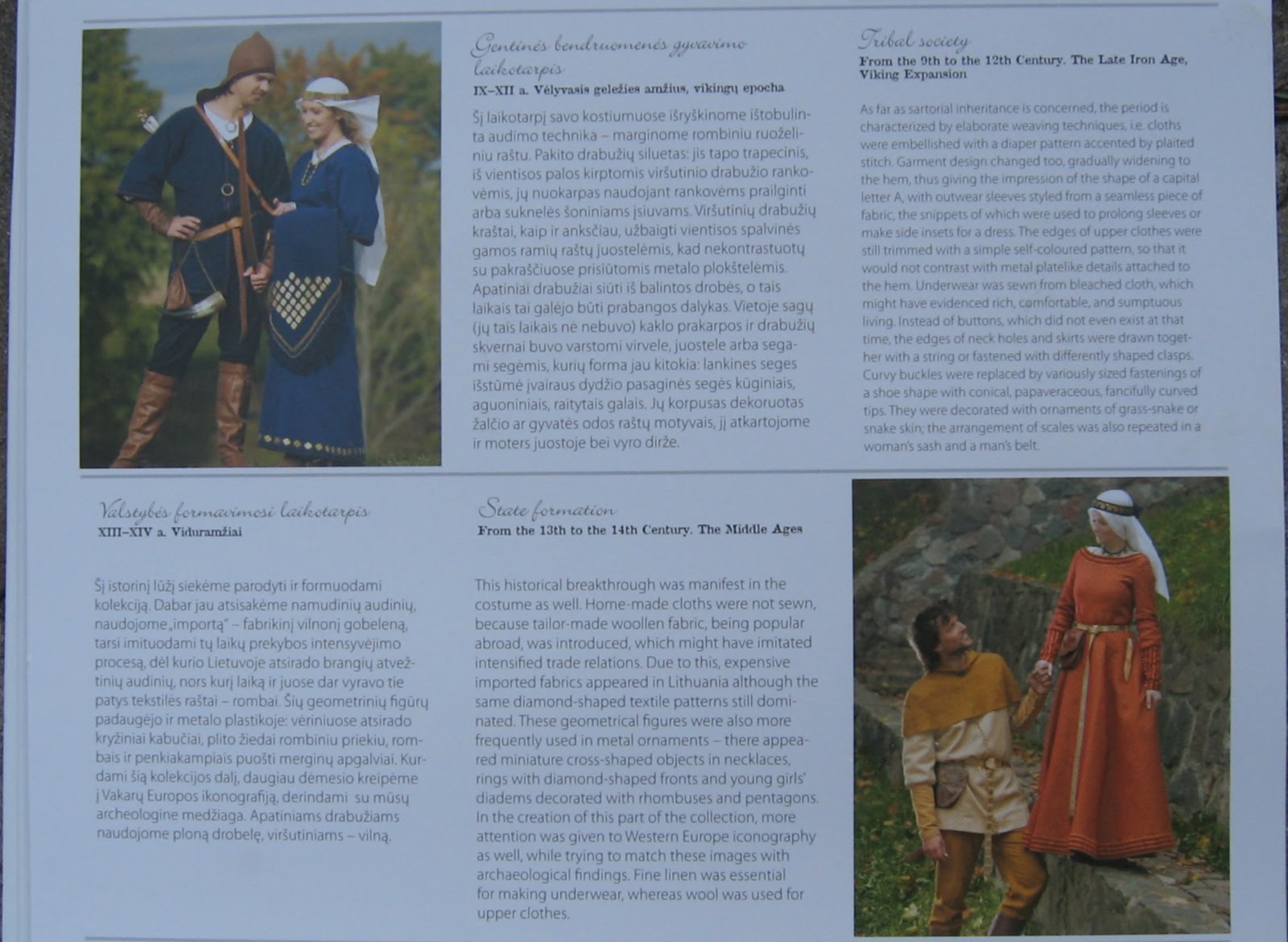
The full-length photograph, for May, is a Viking period costume.  On the back of the page are a series of inset photographs showing portions of the costume in more detail. There is also a summary page that shows smaller images of both the male and female costumes for each era, with commentary in both Lithuanian and English. I have provided a photograph of that entire page, plus a photograph of the part of the page with the Viking period costumes, for easier readability.

Summary page, Viking and Early Medieval sections
Summary page from calendar
If only the calendar gave bibliographic references, it would be perfect.  It does give credits for who made the costume recreations.  I shall have to look at that  information in greater detail.

The photographs should be clickable for size, but that's not working for some reason (it's not working right for photographs I posted earlier on other blog entries either). I apologize for that.  Here is a link you can use to see these photos zoomed up a bit; that will make most of the text readable.

I'm finding these images fascinating, though none of them bear a great resemblance to the images from Regina Volkaite-Kulikauskiene's book (or the costume I was trying to make based on that book).  I expect I'll finish the costume anyway--costume recreation is a moving target, after all.  I have a post planned about that costume, when I get a bit farther along on my work on the shawl for it. 

Note:  The text background on all of these pages should be white, not blue; the color is probably caused by the fact that these photos were taken near the end of the day when the sunlight was starting to fade.

My Lithuanian Costume Calendar Came Today!

Of course, I finally did break down and order the Lithuanian Costume Calendar from BalticShop.com.

The webpage does warn that the calendar measures 28" by 10" (70 cm by 30 cm), but I hadn't realized how large that is--it's huge! So huge that they shipped it rolled up, in a box.  But I'm sure I can flatten it back out again--I do own a copy of the full Brittanica encyclopedia in hard copy.  :-)

As a calendar, it's a bit of a failure, because the section where the actual dates appear is small and narrow (about 4 inches tall--and each month includes the dates for both 2010 and 2011). But that means the costume photographs are HUGE--they take up most of the rest of each page. Better still, on the back of each month's page is a bit of descriptive text in English, with captioned photographs of various details of the featured costume.

I plan to try to photograph some of the back of the pages later, to give an idea of how much they have packed into this calendar. (Though, unfortunately, there are no citations to sources.) Given that's it's a two-year calendar as well, it's worth the money I paid for it.