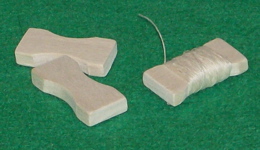
A few years ago, inspired by some research done by pearl, I assembled a plausible Viking-era sewing box and wrote about it here.
A few days ago, I was thinking about sewing kits (i.e., assemblages of sewing equipment kept in a special container) again. This time, it occurred to me that there are pages about period sewing equipment other than pearl's sewing box project (which can be found here) and it might be a public service for me to list some of them.
For example, this site features research by Jennifer Baker, including photographs of period textile tools, for the late Anglo-Saxon period. Here, someone whose SCA persona name is Coblaith Muimnech has written about assembling inexpensive medieval sewing kits to use as gifts.
For anyone who wants to assemble their own sewing kit and document it from scratch, Karen Larsdatter provides links to a wide range of images of sewing and photographs of actual surviving Early Period sewing kits and sewing equipment here. Over here, there is a sketch and other information about a 7th century C.E. Anglo-Saxon box that might also have been used as a sewing kit.
It's important to remember that sewing kits come in all shapes and sizes, and probably always have done so. For example, Penelope Walton Rogers notes, in her book Cloth And Clothing in Early Anglo-Saxon England, AD 450-700* that it's possible to deduce that women in early Anglo-Saxon England often wore soft bags at their waists from the number of archaeological finds of small lumps of sewing materials--needles, balls of thread, etc.--found close to the skeleton between waist and thigh level:
Clusters of objects are often found between the waist and thigh in women's graves, generally on the left-hand side, and sometimes as low as the knee or calf. These were probably suspended from the belt, either individually or in a bag, and are therefore termed 'girdle groups' or 'purse groups'. ... The bags themselves may be represented by ivory rings, 100-150 mm across, which formed a frame for the bag mouth; or by a variety of iron and copper-alloy rings, which may be from smaller, sock-like bags. Other metal rings, however, are clearly for the suspension of objects such as keys, while further examples seem to be part of the general bric-a-brac kept in the bag. This bric-a-brac includes broken brooches, clews of thread, textile hand-tools, beads, amulets, glass cullet, and all sorts of objets trouvés.Page 134 (internal citations omitted). So at least in early Anglo-Saxon England, "workbags" are period. Some of these bags apparently had rings to control the opening. I think such bags worked somewhat like this kind of medieval bag design.
After the Middle Ages, intact and partially intact sewing kits are more likely to be found. Eighteenth-century kits were likely to be assembled in a fabric pouch or wallet, as with the example of a reenactor's kit and research here. Such kits were called "housewives" or some variation of that word and were still being made and used as of the American Civil War; a photograph of a surviving housewife may be found here. World War II servicemen in the Canadian army received a strikingly similar kit, a picture of an original appears here.
How sewing tools were kept during a particular period doesn't really tell us much about the history of clothing, but it does tell us much about how sewing was regarded, how valuable the tools were, and who was doing it. In later periods, for example, military men were issued sewing kits because it was not practical for them to have someone else repair their clothing in the field so they needed to be able to conveniently carry sewing tools with themselves. One wonders why Anglo-Saxon women carried their textile tools with them, and whether Viking women did keep thread and sewing tools that could not easily be hung from brooches in special bags, baskets, or boxes. It would be hard to believe that they did not, but until a seamstress's equivalent of the Mastermyr box is found, we won't know for sure.
EDIT: (7/21/2013) I was wrong about the absence of Viking sewing box finds. I just learned from Carolyn Priest-Dorman that there are archaeological finds of Viking era sewing boxes. At least one, a wooden box with iron bands, was found in the Viking era cemetery in Cumwhitton, Cumbria in England. A copy of the journal in which an illustrated article about the box was published may be downloaded here.
How sewing tools were kept during a particular period doesn't really tell us much about the history of clothing, but it does tell us much about how sewing was regarded, how valuable the tools were, and who was doing it. In later periods, for example, military men were issued sewing kits because it was not practical for them to have someone else repair their clothing in the field so they needed to be able to conveniently carry sewing tools with themselves. One wonders why Anglo-Saxon women carried their textile tools with them, and whether Viking women did keep thread and sewing tools that could not easily be hung from brooches in special bags, baskets, or boxes. It would be hard to believe that they did not, but until a seamstress's equivalent of the Mastermyr box is found, we won't know for sure.
EDIT: (7/21/2013) I was wrong about the absence of Viking sewing box finds. I just learned from Carolyn Priest-Dorman that there are archaeological finds of Viking era sewing boxes. At least one, a wooden box with iron bands, was found in the Viking era cemetery in Cumwhitton, Cumbria in England. A copy of the journal in which an illustrated article about the box was published may be downloaded here.
* I looked up Cloth and Clothing in Anglo-Saxon England on Amazon to confirm that I'd gotten the title right before tracking down my copy to reproduce the quote. When I did so I learned, to my sorrow, that copies are selling on Amazon Marketplace at prices ranging from $325.00 USD to $900.00 USD. Apparently, Cloth and Clothing in Anglo-Saxon England is already out of print; I paid about $35.00 USD for my copy when it first came out in 2007. Sigh.