Showing posts with label Lithuanian. Show all posts

Sunday, August 13, 2017

A Theory About Spiral Tubes

About a week ago, I passed along a link to an article on EXARC.net about the historical use of tiny bronze spiral tubes as a clothing decoration.

My husband, who reads my blog posts via Google Plus even when they are extremely esoteric, found the idea of decorating one's clothing with woven-in metal bits prone to tarnish intriguing.  "How could you possibly clean them?" he asked me.

I observed that such ornamentation was almost certainly confined to one's best clothing, which would be seldom worn and carefully stored.  But he pointed out that likely over time the rings would tarnish badly, anyway, unless they were carefully cleaned from time to time, and they certainly could not be removed to do so.

For some reason, I remarked that spiral-ornamented garments were made from wool, and that perhaps the natural lanolin in the wool helped prevent tarnishing.

That's when my husband came out with the following theory.

Perhaps the owners of such spiral-laden garments buffed the spirals, from time-to-time, with lanolined wool fabric or fleece.  Such a coating would be much more likely to protect the tubes from tarnish, and would not damage the fabric to which they were affixed.

The beauty of this theory, to me, is that its plausibility could easily be tested.  Make a garment (or even ornament a sample piece of wool) with spiral tubes.  Brush the tubes with a lanolined cloth, and store.  Make a control garment, or sample, and store it separately, without touching the tubes with lanolin.  Check both at intervals (every 6 months, say, for a year or two), and see whether the lanolin makes a difference to the amount of tarnish on the tubes.

That sounds like a great idea for a short paper.  I should perform the experiment and write it up some time.

Monday, August 7, 2017

Spiral Tubes

From Katrin Kania's blog I recently learned that there is a good, publicly available (but short) article on EXARC.net about the use of tiny, spiral bronze tubes to decorate clothing.

In general, though the time frame when such ornaments were used varies widely by region, the countries that have used this technique are those around the Baltic Sea. The article itself may be found here.  

Although the text is brief and general, there are some wonderful photographs accompanying the article of surviving finds with spiral tube decoration, some of which I have not seen elsewhere. This article and its photos are particularly recommended to those interested in Lithuanian, Latvian, Estonian, or Finnish clothing of the early to late Middle Ages.

Monday, March 4, 2013

New Baltic Calendar

There is a new historical costume calendar on sale at BalticShop.com. You can see a picture of the cover here. It is a 24-month calendar for 2013-2014 and is titled, "Curonian Costumes of the 1st to 14th Centuries." Like the other two calendars published to date by the Lithuanian Folk Culture Centre, it sells for $25.00 USD; BalticShop.com charges $3.95 USD for shipping to locations in the continental US.

Because of my limited budget (and because I already have the folk-costume calendar published by the Folk Culture Centre for 2012-2013), I probably won't be buying this calendar this year, but the cover picture alone convinces me that it contains useful information (and gorgeous, full-color pictures of reproduced costumes). Hopefully I will be able to afford a copy in time for 2014. EDIT: (4/10/2014) I'm a right idiot. I *have* this calendar. I don't know what made me think it was a different one. Sadly, I discovered this by ordering it and opening the box when it arrived today. Nothing like stress to make one stupid. :-(

Sunday, November 18, 2012

The Lithuanian Folk Costume Calendar 2012-2013

Back cover
Front cover
The Lithuanian Folk Costume Calendar that I had ordered from BalticShop.com arrived late last week.  It  was packed loosely rolled up with bubble wrap in a box.  Our local mail carrier thoughtfully set the box right squarely in the middle of the doormat, where I involuntarily stepped on it as I was leaving my house  that afternoon. (Fortunately, I didn't place my full weight on the box, and it seems to have lost any disfiguring creases after hanging on the wall awhile.)

This calendar follows a similar format to the calendar of recreations of early Lithuanian costume that the Lithuanian Folk Costume Center published for 2010-2011, which I wrote about here. Each month of the new calendar has a large, full-length photograph of one or more people in costume along with the actual calendar portion (on the bottom tenth of the page), and the back of each page contains explanatory text in English and Lithuanian along with smaller photographs of particular portions of the costumes.

When most people (including me) think of European "folk costume" they think of garments that look more or less like the clothing on this page; colorful, charming, festive, but impractical looking and hard for the untrained eye to distinguish from folk costume of any other nation in Europe. The costumes in this calendar are equally festive, but they also show garments that look comfortable, and could have been worn on a daily basis instead of just being festival wear. They also show headwear that bears a distinctive resemblance to some of the recreations of early period Lithuanian costume (though that might just mean that the reconstructors assumed that some of the draped veils of folk costume were early period survivals).

January
December
November
October
Some of the costumes show clear influence from fashionable European costume from one or more periods during the Victorian era. This is particularly obvious in the frock-coat-style garments worn by the few men featured in the calendar. The women's clothing also show such influence, however.  For example, some of the women's costumes have the very high waists that were popular during the first decade of the 19th century CE, while others sport the bold plaids that were fashionable in mid-Victorian costume.

Space and intellectual property considerations keep me from photographing the entire calendar front and back, and I'm not much of a photographer anyway, but even these poor photographs should give you an idea of whether this calendar is worth your money. (If you click on them, you will be rewarded with a much larger and clearer view of the image.)  BalticShop.com is charging $25.00 USD for the calendar, and if you are located in the continental United States shipping is $3.95 USD; I don't know what the shipping rates are for other locations.

I am very pleased with the calendar, despite my relative lack of interest in 19th century costume, because the images are so large and beautiful. I have never before seen so many different and flattering styles of coats in one place! My only regret is that I didn't know about this amazing calendar at the beginning of 2012.  If anyone who reads this has other questions about this calendar and the information it contains, please ask.

Monday, October 1, 2012

New Lithuanian Costume Calendar

Two years ago, the Lithuanian Folk Culture Centre published a beautiful two-year calendar with photographs of reconstructed costumes from early in Lithuania's prehistory up to the end of the Middle Ages. I bought a copy from Baltic Shop.com, and blogged about it here

I just learned that the Folk Culture Centre has published a new calendar for 2012/2013. This one is based upon seasonal costumes, though I can't tell from the description at Baltic Shop.com what historical period is involved.  Baltic Shop.com's write up about the calendar, along with a photograph of the calendar's cover, appears here

2012 is nearly over, but I still need a calendar for 2013, and I'd been hoping that a second Lithuanian costume calendar would be produced. So I'm planning to buy this calendar, and will describe it as soon as I receive it.

EDIT: After reading Patricia's comment, I went to the Lithuanian Folk Culture Centre's website, which confirmed her guess that "national" (i.e., "folk") costume from the 19th-early 20th centuries is what the calendar depicts. Their description of the calendar reads, in relevant part:
The variant of the national costume, which is becoming more and more dominant in present Lithuania, is precisely reconstructed traditional festive clothing of Lithuanian peasants of the 19th - the beginning of the 20th centuries. Such garments are usually reconstructed with the help of surviving ancient pieces of clothing, the drawings and descriptions of those times, and, naturally, the scientific research on this historical heritage. The largest collection reflecting systematically the reconstructed costumes of all five ethnographic regions of Lithuania (i.e. Aukštaitija, : Žemaitija, Dzūkija, Suvalkija, and the Region of Klaipėda) was developed at the Lithuanian Folk Culture Centre in 2004. The initial collection was comprised of eighty-seven national costumes and was supplemented annually with newly reconstructed garments. This calendar has been illustrated with the pictures of clothing from the aforementioned collection.
Most photographs of "folk" or national costume feature festive garb that would only be wearable in the spring or summer, so a collection of photographs of such garb from all seasons of the year should still be interesting.

SECOND EDIT (10/3):  I ordered the calendar today.  I'll provide a representative collection of photographs of the images from it once I receive it (BalticShop.com states that it will be delivered in 2-3 weeks).

Sunday, November 14, 2010

The Lithuanian Costume Calendar--A Closer Look

As I continue to peruse my Lithuanian costume calendar, I find it presents me with more questions than answers, despite the plenitude of gorgeous, full-color recreations of costume.

Most of my previous information on Lithuanian early period and medieval costume came from a book by Regina Volkaitė-Kulikauskienė called Senovės lietuvių drabužiai ir jų papuošalai, published in 1987, which also addressed Lithuanian costume between the first and sixteenth centuries CE.  Although there are differences between the late medieval costumes shown in  the calendar and in Ms. Volkaitė-Kulikauskienė's book, I'm more interested in early period costume, and thus have focused on the differences in the way early period costume has been presented in each.

In general, the calendar's reconstructions agree well with those in  Ms. Volkaitė-Kulikauskienė's book with regard to types of textiles used, colors used (i.e. undyed linen and woolen overgarments in brown or dark blue), footwear, and headwear.  Both clearly show the circlets made from bronze coils that I've come to think of as characteristic of Lithuanian early period costume. Some of these differences may be the result of increased information since 1987, but others strike me as puzzling.
  • The early period reconstructions show tunics over shifts instead of wrapped skirts over shifts, and the Viking age costume shows many bronze plaques sewn to the openings of the tunic (sleeves and hem) in addition to tablet-woven bands.  The earliest period tunic is shown as being split down the sides from about knee-level to the hem, with the edges of the split trimmed with tablet-woven bands.  I'd love to know the find or finds that supported that reconstruction.
  • There are no paired stick pins united by multiple draped chains, which I also associate with early period Lithuanian costume, and few stick pins in general (one is being worn to hold the man's rectangular cloak shut in the I-IV CE costume).
  • One motif that appears in a number of finds (and that shows up in a number of photographs and drawings in Ms. Volkaitė-Kulikauskienė's book) are bronze pendants shaped like maple seeds.  They appear as dangling ornaments on circlets and caps, hung from the chains between the big stick pins used to anchor shawls, and as heads of stick pins.  None of those pendants are shown here, however.  
I suppose the likeliest possibility is that Volkaitė-Kulikauskienė discussed finds from one section of the country and the calendar's costumes are based on finds from a different area.  I don't know Lithuanian geography at all, so I don't really know where any of the finds are located relative to other finds just from reading the names of the find areas.  However, the  text of the calendar discusses each costume as though it is representative of the country as a whole--which is misleading if there truly are distinct regional trends. 
    As pearl has already noted in her blog, the text on the calendar as well as the  reconstructions is the work of archaeologist Daiva Steponavičienė, who is associated with the Castle Research Center „Lietuvos pilys“.and was apparently involved in the reconstruction of the Palace of the Rulers of the Grand Duchy of Lithuania in Vilnius.  Danutė Keturakienė is credited as the "costume designer" of the "archaeological costumes", which I assume means the early period costumes where the reconstruction is based upon archaeological finds.  Although Dr. Steponavičienė's interests appear to center upon the late Middle Ages, Ms. Keturakienė's work appears to be relevant to my period of interest. It will be interesting if her name turns up any articles that might be useful.

    EDIT:  Ms. Danutė Keturakienė is also a weaver, apparently. She's involved with a site called "Ethnic Art" that  gives some information about historic costume and other crafts and sells reproductions of historic Lithuanian textiles, jewelry, ceramics, etc. The site may be found here. 

    Saturday, November 6, 2010

    My Lithuanian Costume

    I've previously mentioned in this blog that I've been making a tenth century CE Lithuanian costume. Actually, most of it has been made for a long while, but I got stuck on the shawl. However, I realized recently that I've made enough progress that it's worth trying the entire costume on (something I hadn't done before now!) and getting a few pictures taken of it to amuse or impress my readers.

    Illus. from R. Volkaite-Kulikauskiene's book
    The costume is based largely upon what I was able to pick up from Compleat Anachronist #59 about Regina Volkaite-Kulikauskiene's book on ancient Lithuanian costume; I've included the relevant picture from Ms. Volkaite-Kulikauskiene's book here for reference. (My costume is based upon the standing figure.). Some confessions  explanations about costume details follow for the curious.

    First of all, the shawl is still incomplete; I need to sew trim on the short edges to conceal the fact that the fringe just consists of pieces of heavy yarn stitched on, and fasten some bronze rings to the shawl for decoration. I'm not entirely sure where I got the idea of red and white fringe for the shawl, but having read the recent article in Medieval Clothing and Textiles 6 I see that the shawl is more Latvian than Lithuanian. Having looked at Ms. Volkaite-Kulikauskiene's picture again, I will probably just make some copper coils, string them on some cord, stitch the cord on parallel to the short ends, and call it good. The pin set is from Raymond's Quiet Press after a find shown in Volkaite-Kulikauskiene's book. They would double as weapons of war; the pins are heavy and long as knitting needles. I gather that the actual pins were just as long, but thinner and lighter (and sharper) than these. I strung chains between them myself.

    The skirt is 100% wool. It is made as a closed tube with a casing for a drawstring. The drawstring has bronze beads dangling from the ends. I had no support for this type of construction,.  However, at the time I made it I had no information of any kind about how the skirt might have been made, and I did know that the early Danes used a closed tube skirt with a cord threaded through the fabric. This seemed like a period-plausible technique.  My fabric was on the thin side; hence, the drawstring. The result produced a skirt that looks a lot like Volkaite-Kulikauskiene's picture above.  I have since learned that the experts believe that the early Baltic skirts were just wrapped fabric, like a modern-day sarong.. I'm not sure I would have used a wrapped skirt for this costume even if I was aware of the theory at the time.  I've always had trouble with wrapped skirts; they usually look ugly on me and tend to unwrap themselves while I'm wearing them (Smallish waist + big hips = problems with wrapping rectangular fabric).  The stitching effect at the bottom of the skirt is the selvedge of the fabric; I think it looks attractive and thus didn't  remove or hide it. 

    The shift is linen and is handsewn.  It's style is generally based on pictures I've seen in Ms. Volkaite-Kulikauskiene's book.   I still have no idea why she believes women's shifts had a collar, but I've seen another Lithuanian reproduction costume on the Internet with a similarly collared shift, and I thought it was possible that there was a neckring find with textile impressions inside the ring that I'd never heard of to support the interpretation, so I made the shift that way.  I purchased the neckring from an Internet dealer; it looks a lot like the ones I've seen in reconstruction pictures, including the reconstruction pictures on my Lithuanian costume calendar.

    The apron is a very light wool gabardine, and is belted on in the manner in which the Eura apron is believed to have been worn, again because I had no better clue how the apron might have been worn. The belt is a "folk" Latvian design, purchased from BalticShop.com largely because I thought it would fit in with the other costume components and knew that it would have taken me much longer to tablet weave something vaguely appropriate myself. The shoes are also from BalticShop.com. I've made linen stockings, which I was planning to wear with the costume, but I couldn't find the pair I made for myself (they fit much better than these!) so I'm wearing a pair I bought from Historic Enterprises. (I haven't made myself any cut-and-sewn stockings from wool--yet.)

    I made two different headdresses to wear with this costume: 1) a circlet, made from bronze beads (based on a sketch from CA #59 that I may have misinterpreted and don't know the provenance of) strung on elastic cord (I couldn't figure out how better to fasten it, though the originals must have tied) and stitched to a leather band, with a series of hanging chains  fastened to the back, each with a bell on the end, and 2) a veil and wimple, pinned with a "maple leaf" headed pin that I made myself of craft bronze. (You don't want to see it close-up, believe me; it's pretty crude.) The veil is wool challis; light, warm, nicely draping. It was somewhere close to $20 USD a yard; fortunately that quantity was all I needed for a veil and wimple. Please excuse the sloppy draping of the wimple, but I wanted to get the photographs  taken outside before dark, and because we're heading toward winter we lose the sunlight fairly early in the afternoon now. I folded the veil (which is nearly square) into a triangle to wear it, largely because I think triangular veils look better.  The recreations featured in the Lithuanian costume calendar use rectangular veils, which always look ugly to me and don't particularly seem to match any of the artistic depictions with which I'm familiar from the eras when veils were commonly worn.

    I can't say this costume is based on especially rigorous research.  But I did learn a lot about working with natural materials, and about handsewing, in assembling it, and I've also learned more about early medieval Baltic costume over the period I've been assembling it.  So although I don't think this costume qualifies as a recreation, the process of making it has taught me about period costume in general, and about Baltic area costume of the period in particular.  Also, I think this costume does convey at least a bit of the flavor of Lithuanian costume of the period and how Lithuanian costume differed from the costume of the other Baltic areas.

    One final observation:  except for the shawl and veil, the costume is quite comfortable; I wore it while typing in the first draft of this post. 

    Kudos to my husband for taking the photographs you see here. (I've eliminated the ones with dopey expressions or other major problems.) I will probably post a photograph of the costume once more, after I've finally finished the shawl--and at that point, I'll make sure to take more care with my headgear. 

    Saturday, October 23, 2010

    Lithuanian Costume Calendar--Photos!

    I still haven't gotten to sit down and admire my new Lithuanian Costume Calendar.  Instead, I hurried outside so that I could take some representative photographs of a few interesting pages before dusk (I can't take good photographs of them indoors because the flash creates reflections that obliterate some of the detail in the images). The images may not appear to be perfectly rectangular because the calendar was mailed rolled-up in a box, and it's still flattening back out. 

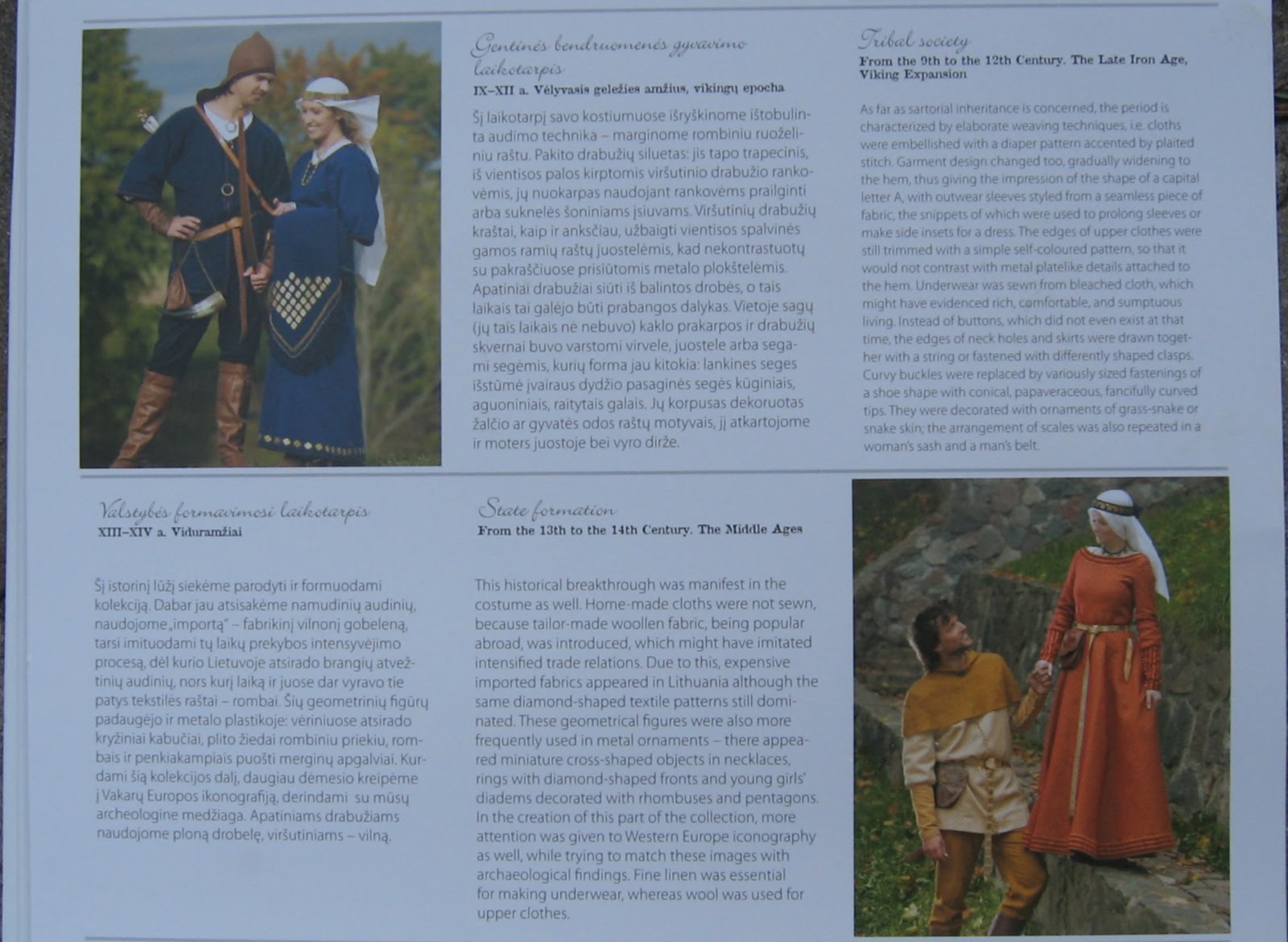
    Viking era costume, full length
    Viking era costume, back of page

    The full-length photograph, for May, is a Viking period costume.  On the back of the page are a series of inset photographs showing portions of the costume in more detail. There is also a summary page that shows smaller images of both the male and female costumes for each era, with commentary in both Lithuanian and English. I have provided a photograph of that entire page, plus a photograph of the part of the page with the Viking period costumes, for easier readability.

    Summary page, Viking and Early Medieval sections
    Summary page from calendar
    If only the calendar gave bibliographic references, it would be perfect.  It does give credits for who made the costume recreations.  I shall have to look at that  information in greater detail.

    The photographs should be clickable for size, but that's not working for some reason (it's not working right for photographs I posted earlier on other blog entries either). I apologize for that.  Here is a link you can use to see these photos zoomed up a bit; that will make most of the text readable.

    I'm finding these images fascinating, though none of them bear a great resemblance to the images from Regina Volkaite-Kulikauskiene's book (or the costume I was trying to make based on that book).  I expect I'll finish the costume anyway--costume recreation is a moving target, after all.  I have a post planned about that costume, when I get a bit farther along on my work on the shawl for it. 

    Note:  The text background on all of these pages should be white, not blue; the color is probably caused by the fact that these photos were taken near the end of the day when the sunlight was starting to fade.

    My Lithuanian Costume Calendar Came Today!

    Of course, I finally did break down and order the Lithuanian Costume Calendar from BalticShop.com.

    The webpage does warn that the calendar measures 28" by 10" (70 cm by 30 cm), but I hadn't realized how large that is--it's huge! So huge that they shipped it rolled up, in a box.  But I'm sure I can flatten it back out again--I do own a copy of the full Brittanica encyclopedia in hard copy.  :-)

    As a calendar, it's a bit of a failure, because the section where the actual dates appear is small and narrow (about 4 inches tall--and each month includes the dates for both 2010 and 2011). But that means the costume photographs are HUGE--they take up most of the rest of each page. Better still, on the back of each month's page is a bit of descriptive text in English, with captioned photographs of various details of the featured costume.

    I plan to try to photograph some of the back of the pages later, to give an idea of how much they have packed into this calendar. (Though, unfortunately, there are no citations to sources.) Given that's it's a two-year calendar as well, it's worth the money I paid for it.

    Tuesday, January 12, 2010

    LIthuanian Shawl Update

    Remember my 10th century Lithuanian shawl? The item that's supposed to complete my (roughly) 10th century Lithuanian costume? The one that hasn't been touched in three no, four no wait, how many? years?

    I'm still not clear how I'm going to get brass rings onto it, but tonight I started implementing my idea for putting fringe on the narrow ends. I think it will look rather nice, even though it is a bit of a kluge. (But then, this project dates to the time when I was still doing most of my costuming with a sewing machine--to resume it now and expect it to look 100% authentic is unrealistic).

    There will be photographs when there's some reasonable-looking progress, which may be in a few days.

    Saturday, December 5, 2009

    Article on Lithuanian Diamond Twills

    While idly searching for more information on diamond twill fabric, I found this article about diamond twills used for the skirts worn as Lithuanian folk costume during the late 19th and early 20th centuries.  (Pearl; have you seen this article?)

    The authors examined 257 skirts for the article. 55% of the skirts were simple plain weave (by which I assume the authors mean "tabby"), and only 24% were twills. (The rest were either combination weaves or satin weaves). Of the twill weaves, in turn, 41.6% were 2/2 twills; only 15% of the twills are diamond twills, and it's clear from the weave diagrams that appear in the article that many of the diamond twills are not simple broken or unbroken twills but odd, unusual variants that would not have been seen in the Viking Age. On the other hand, the fact that diamond twills are a minority of the twills found is pretty much the same as in Viking Age Scandinavia. (Though I believe tabby weave was less common in the Viking Age than in this sample of folk skirts.) Most of the skirts were wool, though I recall one wool-cotton blend being mentioned.

    It's an interesting little article, and I commend it to the attention of any Baltic costume enthusiasts and weavers who read this blog.

    Lithuanian Circlet Surprise

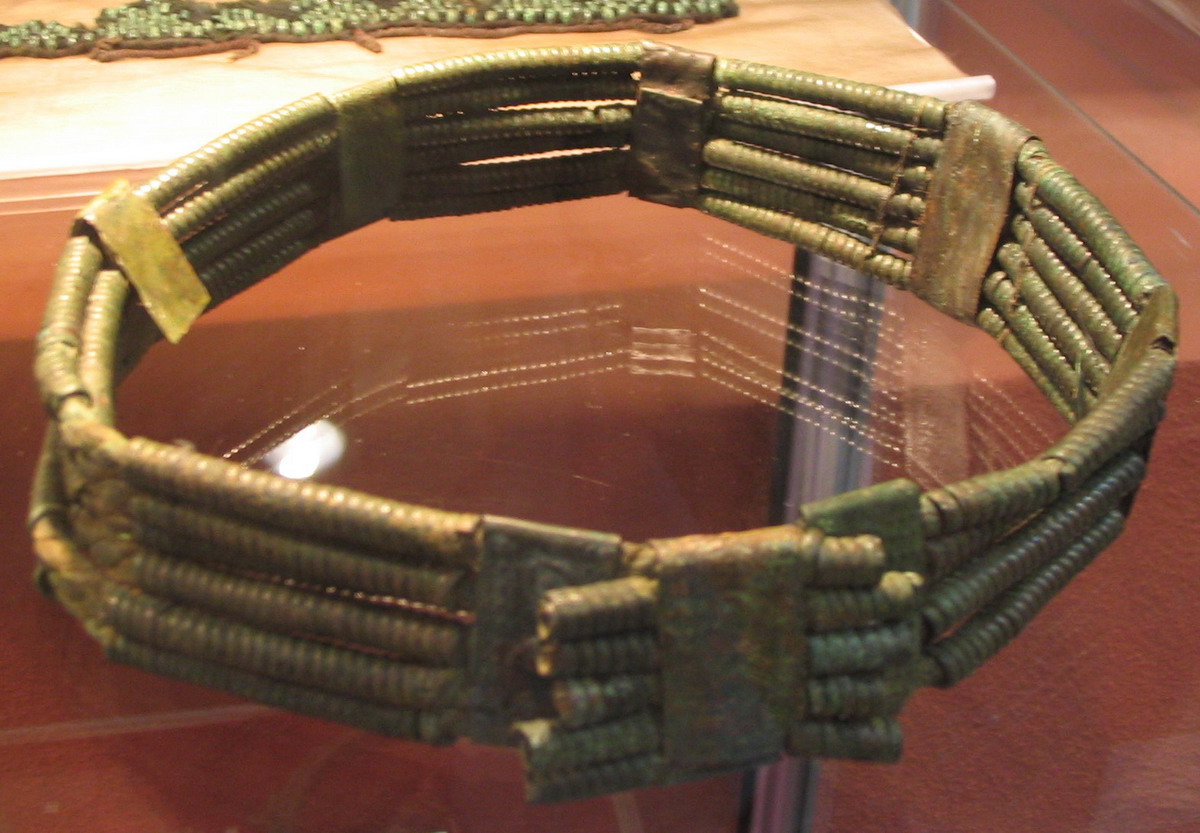
    Today I was looking through Pearl's LiveJournal for interesting links I had previously missed. I found this link to color photographs of items from an exhibition in a Russian museum called (in translation) "Russia and the Baltic in the Viking Age". She noted that some of the photographs showed "the coiled bronze circlets from the back!!"

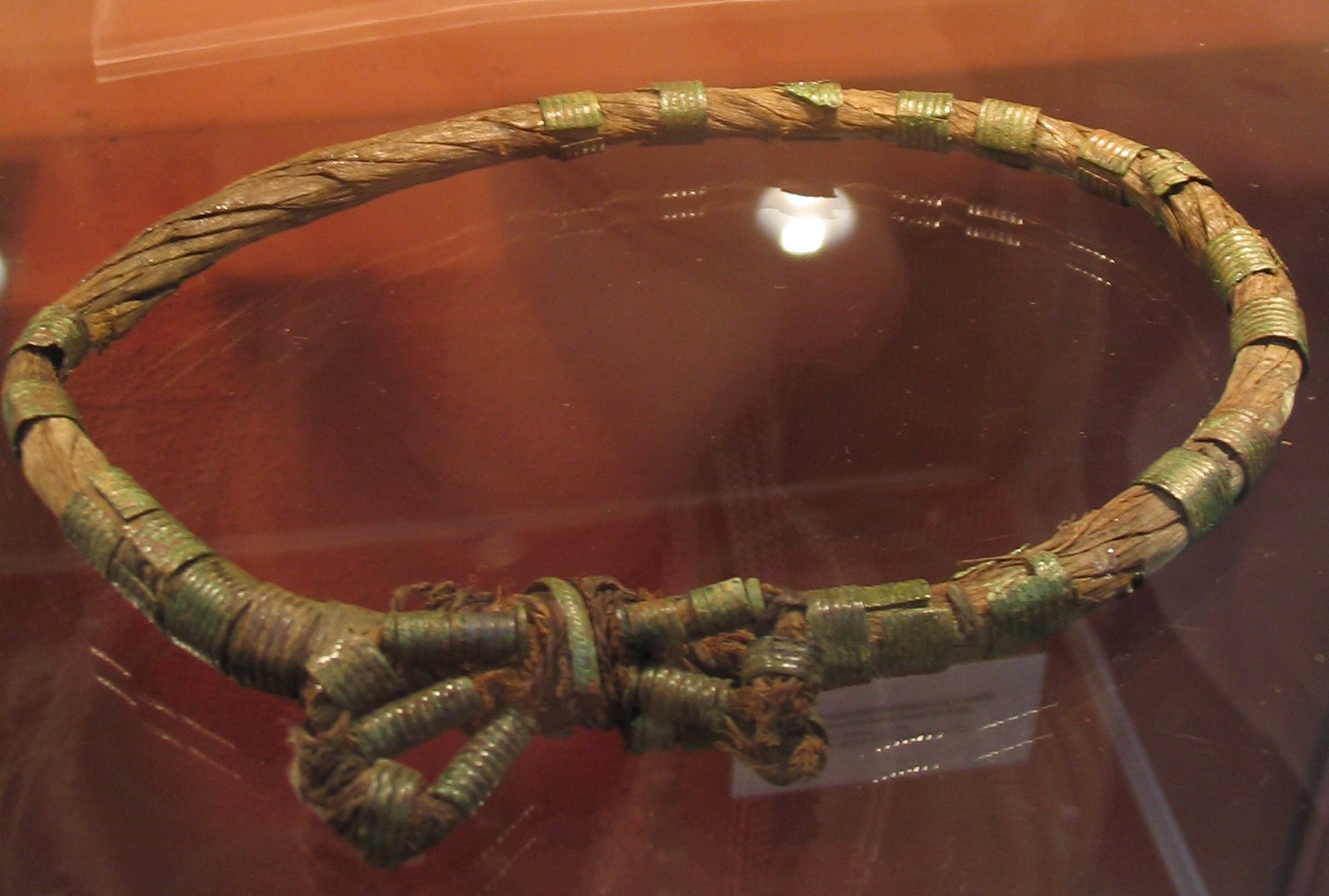
    I assume Pearl was referring to this photograph in particular. While it's true that the photograph shows the circlet from the back, what is more interesting about the photograph, to me, is that the "coils" aren't really coils. They are long beads with ridges or crimps impressed into them at regular intervals, to make them look as though they were wire coils. Of equal interest is this photograph, which shows a second circlet, one missing much of its metal. The "coils" are metal beads with crimps making them look like short coils, and the ones that are left are mounted on what appears to be a leather rope--an interesting insight into the construction of such items.

    I wouldn't say from these photographs that all Lithuanian circlets are made from fake coils. This page showing 5th to 9th century items shows a circlet that actually does appear to be made from wire coils. But it is interesting to see that at least some of the circlets (possibly the later ones? The Russian exhibit page does not give dates or provenances of the items depicted) are made of fake coils.