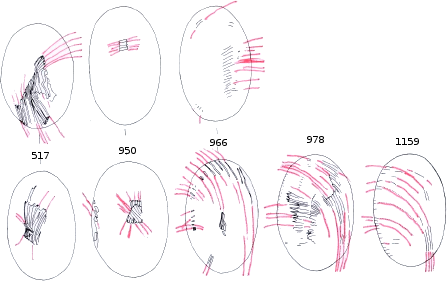
Last week, while I was re-reading Hilde Thunem's essay-in-progress about Viking women's shifts yet another time, I had a revelation about the evidence. Specifically, my revelation was about the fragments of tightly pleated fabric, believed to be from shifts, that were found inside many tortoise brooches at Birka.
Ms. Thunem notes in her essay that the pleated fragments usually bend in one direction or another. She regrets the fact that Hjalmar Stolpe, who originally excavated those graves, did not take note of which brooch was found on which side of the body: "This means that there is no way of identifying the left-hand and right-hand brooches, and consequently no way to learn whether the bending of the pleats always pointed towards the shoulders, always towards the throat or differed from one serk to another."
When I first read the essay, I agreed with her sentiment. But now I wonder whether the fact that the pleats show a bend is sufficient information to allow us to deduce one more element about how those shifts were made.
Think of the problem this way. How many different ways are there to pleat a shift? One approach, surely, is to pleat the entire width of the garment to the neckband, as the Pskov shift must have been made. Probably additional work would need to be done to ensure pleats as deep and tight as in the fragments found in the Birka brooches, but the direction of the pleats would at least be determined. As can be seen from the picture to the left from the Adamklissi monument, which depicts a shift pleated to the neckband (though with some puzzling pleats on the short sleeves), the pleats in the area of the upper chest where the tortoise brooches likely appeared would tend to bend toward the centerline of the body, away from the shoulders.
How else might the shifts have been pleated? In theory they could have been pleated horizontally, with the pleats running across the torso, but it's clear that they were not pleated in that manner, because as Ms. Thunem notes, "there seems to be a tendency for the pleats to run in parallel with the needle in the brooch, and then bend towards one side of the brooch." If the shifts were horizontally pleated, that would not be the case--the pleats inside the brooches would be perpendicular to the needles in the brooches instead. So it's clear that the pleats on the Birka shifts ran down the torso of the wearers, instead of across it, a pleating direction I'll refer to in the rest of this essay as "vertical" pleats.
What other ways could the shifts have been pleated, other than to a neckband, that would result in vertical pleats? If those methods would not be likely to result in vertically pleated clumps inside the tortoise brooches, those methods cannot have been used.
I can think of three methods other than the neckband method of pleating a shift. One is simply to pleat the shift, which is cut with a round or keyhole-style neckline, across its entire width. This is the method the Historiska Museet used in its Viking women's costume reconstruction. A variation of this approach would be to pleat the shift from the edges toward the center, starting at the shoulders. However, a tortoise brooch, placed on the relevant upper chest area, would not show any bending of the vertical pleats.
The second possibility is to permanently pleat the body of the shift, perhaps even stitching the pleats down, from a particular point on the torso, such as just above the nipples. In that circumstance, whether any pleats at all would even show would depend upon the point at which the pleats started. With this design, pleats would not appear in the brooches at all unless the line of pleats started at the armpit level; the neckline would make it challenging to start them higher.
The third possibility is to pleat the shift from the shoulders, as above, but with the pleats running diagonally toward the shoulders and the centerline of the body, like the Faltenklied figure on the Adamklissi monument, shown on the right. Pleats based on this model would accordingly show a bend outward, toward the shoulders.
However, there are other factors that make the Faltenklied type of pleated garment unlikely to have been the model for the finds at Birka. The Faltenklied figures are plainly men, not women; men from the Roman era, not the ninth and tenth centuries CE like the Birka women. On the other hand, the neckline pleated shifts of the Adamklissi women are similar to the Pskov shift remains from the tenth century--remains that are linked by the appearance of tortoise brooches to the Viking world.
So maybe the mere fact that the Birka brooches contain shift fragments with pleats that bend is sufficient evidence to get us a bit closer to a shift design for the Birka women. Although we don't know, and will never know, whether the pleats any of the brooches pointed toward or away from the occupant's shoulders, the Pskov shift evidence makes it a little more likely that any shift with bending pleats was pleated to a neckband, with the pleats bending toward the shoulders.
When I first read the essay, I agreed with her sentiment. But now I wonder whether the fact that the pleats show a bend is sufficient information to allow us to deduce one more element about how those shifts were made.
 |
| Neckband pleated shifts |
How else might the shifts have been pleated? In theory they could have been pleated horizontally, with the pleats running across the torso, but it's clear that they were not pleated in that manner, because as Ms. Thunem notes, "there seems to be a tendency for the pleats to run in parallel with the needle in the brooch, and then bend towards one side of the brooch." If the shifts were horizontally pleated, that would not be the case--the pleats inside the brooches would be perpendicular to the needles in the brooches instead. So it's clear that the pleats on the Birka shifts ran down the torso of the wearers, instead of across it, a pleating direction I'll refer to in the rest of this essay as "vertical" pleats.
What other ways could the shifts have been pleated, other than to a neckband, that would result in vertical pleats? If those methods would not be likely to result in vertically pleated clumps inside the tortoise brooches, those methods cannot have been used.
I can think of three methods other than the neckband method of pleating a shift. One is simply to pleat the shift, which is cut with a round or keyhole-style neckline, across its entire width. This is the method the Historiska Museet used in its Viking women's costume reconstruction. A variation of this approach would be to pleat the shift from the edges toward the center, starting at the shoulders. However, a tortoise brooch, placed on the relevant upper chest area, would not show any bending of the vertical pleats.
The second possibility is to permanently pleat the body of the shift, perhaps even stitching the pleats down, from a particular point on the torso, such as just above the nipples. In that circumstance, whether any pleats at all would even show would depend upon the point at which the pleats started. With this design, pleats would not appear in the brooches at all unless the line of pleats started at the armpit level; the neckline would make it challenging to start them higher.
 |
| Faltenklied tunic/shift |
However, there are other factors that make the Faltenklied type of pleated garment unlikely to have been the model for the finds at Birka. The Faltenklied figures are plainly men, not women; men from the Roman era, not the ninth and tenth centuries CE like the Birka women. On the other hand, the neckline pleated shifts of the Adamklissi women are similar to the Pskov shift remains from the tenth century--remains that are linked by the appearance of tortoise brooches to the Viking world.
So maybe the mere fact that the Birka brooches contain shift fragments with pleats that bend is sufficient evidence to get us a bit closer to a shift design for the Birka women. Although we don't know, and will never know, whether the pleats any of the brooches pointed toward or away from the occupant's shoulders, the Pskov shift evidence makes it a little more likely that any shift with bending pleats was pleated to a neckband, with the pleats bending toward the shoulders.
By the way, the bending of the pleats is fairly strong evidence that Annika Larsson was wrong about Viking women wearing their brooches directly over their nipples. If, for example, the Birka women had worn their brooches in such a manner, the pleated fabric remains would have been straight, and would not have bent in either direction, since in any of the shift models that come close to matching the brooch finds the pleats run straight up and down that far down on the body. This is made clearer by the fact that Larsson uses a shift pleated to a neckband like the Pskov find in her reconstruction costume; the photograph clearly shows that the pleats lie straight over the near-waistline location where the brooches rest.