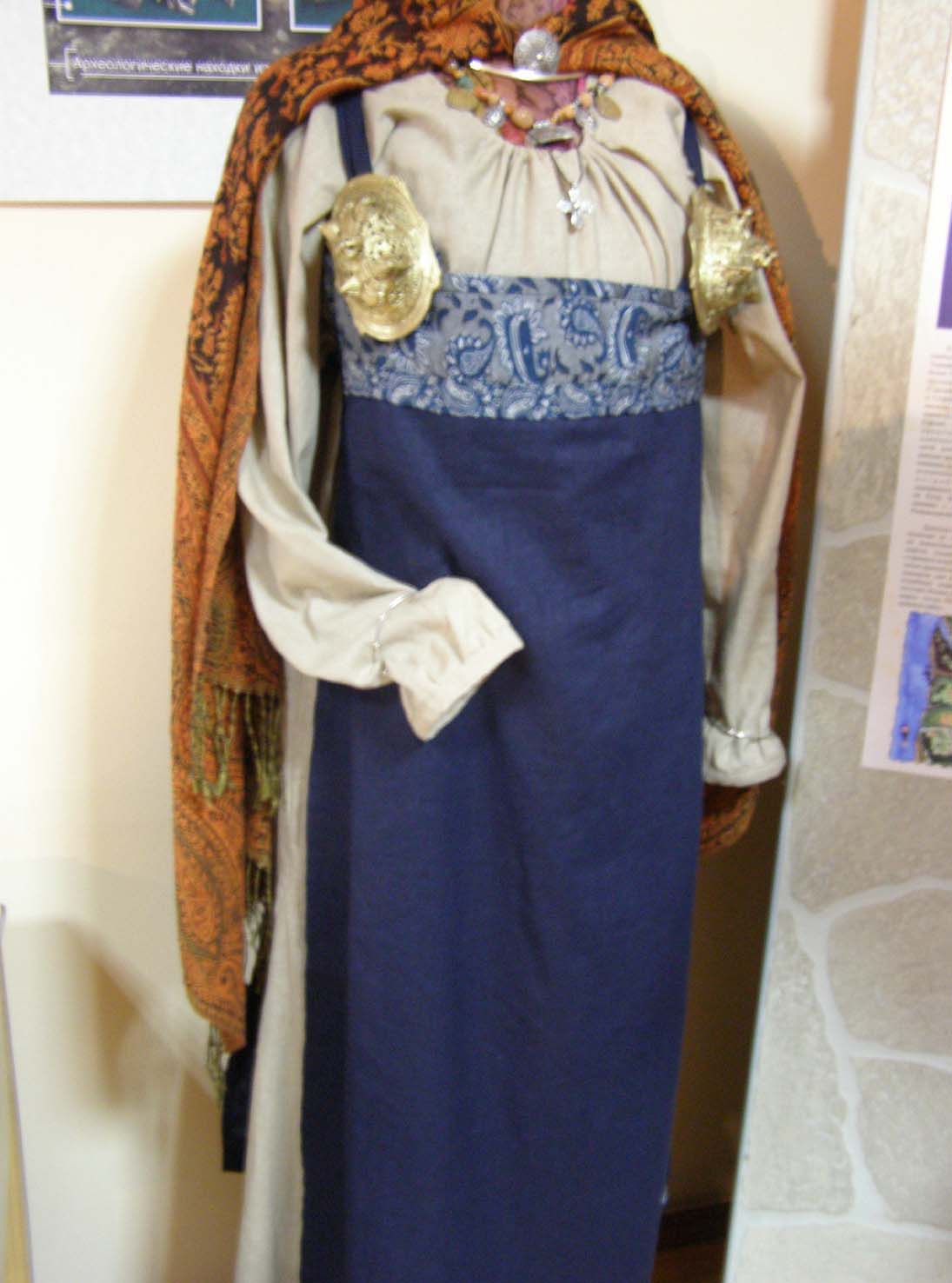
As is often the case, I found this article about the Pskov find while I was looking for something else. It's written in Russian, but the photographs of the textile fragments from Pskov are much clearer and more informative than any other photographs I've seen so far--including the photographs in the official report published in NESAT X. Moreover, the pictures are clickable so that the viewer can see small, medium and large versions, and the amount of detail visible in the medium and large versions is impressive.
The article also includes sketches showing possible reconstructions of the apron dress found in the grave that are different than those offered in the official archaeologists' report. My guess is that this web article was written by a Russian reenactor who has read the Pskov team's reports and is making deductions based on the information.
The article also includes sketches showing possible reconstructions of the apron dress found in the grave that are different than those offered in the official archaeologists' report. My guess is that this web article was written by a Russian reenactor who has read the Pskov team's reports and is making deductions based on the information.
I don't read Russian, but running the page through Google Translate has enabled me to understand enough of the article to determined the gist of the author's suggestions about the find.
As others have done, the article observes that the Pskov apron dress could have been worn wrapped around the body, with the decorated panel in back and the opening in the front. However, this version makes the panel, with its applied decoration of antique silk, harder to see, and is difficult to justify on that basis.
The other suggestion the author makes is more interesting. The author suggests that the front panel was huge precisely because the intended wearer of the dress was very large. We have no information about the wearer of the Pskov apron dress because the dress fragments were found folded inside a birchbark box found in the grave, not on a body, and no body was found. The author states that if the apron dress when draped as a tube was 152 cm (about 59 inches) across, it would fit perfectly if the wearer had a girth of 180 cm (about 70 inches). The front panel would just about cover the upper front of her body, while the rest of the apron dress would completely surround the lower part. Under this view, the Pskov reconstructors theory about how the apron dress was worn is correct, except that there would be no front sagging if the woman was large enough.
This suggestion is not crazy. The Central Asian woman buried in the 13th century CE grave that I blogged about previously was buried in trousers that were 162 cm wide.
The author of this essay also notes that there are at least two ways to reconstruct the linen shift found in the Pskov grave, namely, as a pieced Western style t-tunic with long, straight sleeves, or like the Russian shifts still found in "folk costume", with a gathered neckline and wide, puffy sleeves gathered at the wrists, like a modern "peasant" style blouse. However, what the grave contains actually shows a combination of these forms. There is evidence of a linen garment with gathered neckline, pleated to a narrow strip of fabric that likely was tied, and wide, straight cuffs trimmed with silk. These facts suggest that the neckline was gathered and tied while the sleeves of the shift were straight--again paralleling what the official reconstructors have deduced. That suggests that the woman's costume is a hybrid of the typical costumes of two different cultures--Slavic and Scandinavian.
Perhaps such hybrids were more typical than we can easily confirm. This article in Fornvannen discusses a number of finds in the Gnezdovo area (not far from Pskov) of iron neckrings (a more Slavic style) bearing one or more Thor's hammers. The author's thought is that the hammers were worn by Scandinavian settlers, but it's just as possible that some of the wearers were individuals influenced by both cultures--perhaps the children of Scandinavians who intermarried with the Slavs of the area. More research will certainly be needed to reconstruct the costume worn by women in this part of the world during the Viking period.
As others have done, the article observes that the Pskov apron dress could have been worn wrapped around the body, with the decorated panel in back and the opening in the front. However, this version makes the panel, with its applied decoration of antique silk, harder to see, and is difficult to justify on that basis.
The other suggestion the author makes is more interesting. The author suggests that the front panel was huge precisely because the intended wearer of the dress was very large. We have no information about the wearer of the Pskov apron dress because the dress fragments were found folded inside a birchbark box found in the grave, not on a body, and no body was found. The author states that if the apron dress when draped as a tube was 152 cm (about 59 inches) across, it would fit perfectly if the wearer had a girth of 180 cm (about 70 inches). The front panel would just about cover the upper front of her body, while the rest of the apron dress would completely surround the lower part. Under this view, the Pskov reconstructors theory about how the apron dress was worn is correct, except that there would be no front sagging if the woman was large enough.
This suggestion is not crazy. The Central Asian woman buried in the 13th century CE grave that I blogged about previously was buried in trousers that were 162 cm wide.
The author of this essay also notes that there are at least two ways to reconstruct the linen shift found in the Pskov grave, namely, as a pieced Western style t-tunic with long, straight sleeves, or like the Russian shifts still found in "folk costume", with a gathered neckline and wide, puffy sleeves gathered at the wrists, like a modern "peasant" style blouse. However, what the grave contains actually shows a combination of these forms. There is evidence of a linen garment with gathered neckline, pleated to a narrow strip of fabric that likely was tied, and wide, straight cuffs trimmed with silk. These facts suggest that the neckline was gathered and tied while the sleeves of the shift were straight--again paralleling what the official reconstructors have deduced. That suggests that the woman's costume is a hybrid of the typical costumes of two different cultures--Slavic and Scandinavian.
Perhaps such hybrids were more typical than we can easily confirm. This article in Fornvannen discusses a number of finds in the Gnezdovo area (not far from Pskov) of iron neckrings (a more Slavic style) bearing one or more Thor's hammers. The author's thought is that the hammers were worn by Scandinavian settlers, but it's just as possible that some of the wearers were individuals influenced by both cultures--perhaps the children of Scandinavians who intermarried with the Slavs of the area. More research will certainly be needed to reconstruct the costume worn by women in this part of the world during the Viking period.